
Introduction
Third party cyber risk is becoming one of the biggest security challenges for organizations as vendors, suppliers, cloud providers, and external partners gain access to critical systems, data, and business operations.
In today’s interconnected digital ecosystem, organizations increasingly rely on third parties—vendors, service providers, cloud platforms, and software suppliers—to support their operations. While this interconnectedness enables efficiency and scalability, it also introduces significant information security risks. Third-party relationships often extend an organization’s attack surface beyond its direct control, making them a critical weak point in cybersecurity strategies.
A third-party risk arises when an external entity has access to an organization’s systems, data, or processes. This access may be direct, such as through system integration or remote support tools, or indirect, such as through shared infrastructure or software dependencies. Attackers exploit this trust relationship, targeting vendors with weaker security controls to gain entry into more secure environments.
According to recent industry findings, nearly 30% of data breaches now involve third parties, highlighting the growing importance of supply chain security. According to statistics of 2025 by Black Kite research group, 136 verified third-party events occurred with 5.28 downstream victims per vendor, and 719 companies were publicly named as victims with approximately 26,000 additional impacted companies that were never named.
Key Information Security Risks in Third-Party Environments
One of the most critical risks is unauthorized access to sensitive data. Vendors often process or store customer data, financial records, or intellectual property. If a third party is compromised, attackers can access this data without directly breaching the primary organization. This risk is amplified when organizations lack visibility into how vendors manage and secure data.
Another major concern is inherited vulnerabilities. Organizations may have strong internal controls, but their vendors might not adhere to the same security standards. Attackers deliberately target these weaker links, using them as entry points into otherwise well-defended systems. This creates a cascading effect, where a single compromised vendor can impact hundreds or even thousands of downstream organizations.
Third-party integrations also introduce excessive privileges and persistent access risks. Modern systems rely heavily on APIs, cloud integrations, and OAuth tokens, which often grant broad and long-term access. If compromised, these access mechanisms allow attackers to move laterally across systems with minimal detection. (https://www.hornetsecurity.com/en/blog/cybersecurity-incidents )
Additionally, organizations face limited visibility and delayed detection in third-party environments. Recent research indicates that breaches involving vendors often remain undisclosed for extended periods, with an average delay of over 100 days before public disclosure. This “silent exposure window” significantly increases the potential damage (https://blackkite.com/report/2026-third-party-breach-report )
Recent Real-World Examples of Third-Party Breaches
Only a few recent ones are listed here; otherwise, we can find many:
In 2026, attackers linked to North Korea compromised a widely used open-source package, turning it into a malware delivery mechanism. The package, downloaded millions of times weekly, allowed attackers to steal credentials from downstream users. This incident highlights how even trusted software dependencies can become attack vectors when third-party controls are weak. https://www.axios.com/2026/03/31/north-korean-hackers-implicated-in-major-supply-chain-attack
A major breach affecting over 5.6 million individuals occurred when attackers exploited a vulnerable API connected to a third-party integration partner. The breach persisted for weeks before detection, exposing sensitive personal data. This case illustrates how fourth-party risk (vendor’s vendor) can significantly expand the attack surface. In a statement shared with the media, partners, and affected individuals, 700Credit said that in late October 2025, it suffered a third-party supply-chain attack. https://www.techradar.com/pro/security/massive-data-breach-sees-credit-card-details-of-over-5-6-million-victims-leaked-heres-what-we-know
The UK retailer Marks & Spencer suffered a cyberattack where hackers gained access through a third-party contractor using social engineering techniques in 2025. Notably, the company’s internal systems were not directly breached; instead, the attackers bypassed defenses by exploiting human and process weaknesses in the vendor ecosystem. https://www.reuters.com/business/aerospace-defense/ms-says-cyber-hackers-broke-through-third-party-contractor-2025-05-21
These incidents reveal several recurring themes, few are as follows:
- Attackers increasingly prefer indirect attacks through vendors, as they offer higher success rates and broader impact. A single compromise can affect thousands of organizations simultaneously.
- There is a growing challenge of fourth-party risk, where organizations may not even be aware of all entities in their extended supply chain. This lack of visibility makes risk management significantly more complex.
- Trust-based access models are being exploited. Vendors often operate with high privileges and minimal monitoring, making them ideal entry points for attackers.
- These cases highlight that technical controls alone are insufficient. Human factors, such as social engineering and poor vendor awareness, continue to play a critical role in breaches.
Strengthening Third-Party Risk Management: A Standards-Aligned Approach Using ISO 27001 and NIST
Third-Party Risk Management (TPRM) has emerged as a critical component of effective cybersecurity governance in an era in which organisations are becoming more reliant on external vendors, cloud providers, and service partners. Although third-party relationships facilitate operational efficiency and innovation, they also introduce intricate security, compliance, and operational risks. Structured guidance for managing risks across the supply chain (supply chain cyber security) is provided by globally recognised frameworks such as ISO/IEC 27001 and NIST Cybersecurity Framework in order to address these challenges.
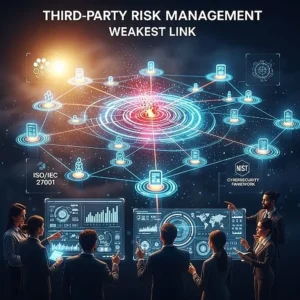
The implementation of a robust TPRM program is a continuous lifecycle process that encompasses vendor onboarding, assessment, monitoring, and termination, rather than a one-time activity. A standards-aligned approach to effectively managing third-party risks is delineated by the following key components.
Risk-Based Vendor Identification and Classification
The foundation of TPRM lies in identifying all third-party relationships and classifying them based on their risk criticality. Not all vendors pose equal risk; for example, a cloud service provider handling sensitive data requires far more scrutiny than a low-impact supplier.
Under ISO/IEC 27001 Annex A, control A.5.19 (Information Security in Supplier Relationships) emphasizes the need to identify and manage supplier-related risks systematically. Similarly, NIST SP 800-53 control SR-1 (Supply Chain Risk Management Policy and Procedures) mandates organizations to establish processes for identifying and categorizing suppliers based on risk as part of their supply chain cyber security.
This classification enables organizations to apply proportionate controls, ensuring that high-risk vendors undergo deeper scrutiny and continuous monitoring.
Due Diligence and Pre-Contract Risk Assessment
Before engaging any third party, organizations must conduct thorough security due diligence. This includes evaluating the vendor’s security posture, certifications, incident history, and compliance with relevant standards to avoid any third party breaches.
ISO/IEC 27001 control A.5.20 (Addressing Information Security within Supplier Agreements) requires organizations to define and agree upon security requirements prior to onboarding vendors. On the other hand, NIST SP 800-161 provides detailed guidance on assessing supplier risks, including evaluating software integrity and operational resilience.
Key assessment techniques include:
- Security assessments aligned with ISO/NIST controls
- Review of audit reports
- Penetration testing or independent assessments
- Evaluation of data handling and encryption practices
This phase ensures that organizations do not inherit hidden vulnerabilities from their suppliers.
Contractual Security and Compliance Requirements
Contracts serve as a critical enforcement mechanism for third-party security. They must clearly define security expectations, responsibilities, and liabilities.
According to ISO/IEC 27001 Annex A, organizations must include clauses related to:
- Data protection and confidentiality
- Incident reporting timelines
- Access control requirements
- Right to audit
Similarly, NIST SP 800-53 control SR-3 (Supply Chain Controls and Processes) emphasizes embedding security requirements into contracts and supplier agreements.
Well-defined contracts reduce ambiguity and ensure that vendors are legally bound to maintain security standards.
Continuous Monitoring and Risk Reassessment
Third-party risk does not end after onboarding. Vendors’ security posture can change over time due to new vulnerabilities, organizational changes, or emerging threats.
NIST Cybersecurity Framework under the “Detect” and “Respond” functions emphasizes continuous monitoring of external dependencies. Similarly, ISO/IEC 27001 control A.5.22 (Monitoring, Review, and Change Management of Supplier Services) requires ongoing evaluation of supplier performance and security compliance.
Effective monitoring strategies include:
- Continuous security ratings and threat intelligence
- Periodic reassessments and audits
- Monitoring for data breaches or leaked credentials
This proactive approach helps detect issues before they escalate into major incidents.
Exit Strategy and Secure Offboarding
A frequently overlooked aspect of TPRM is the secure termination of vendor relationships. Failure to revoke access or retrieve data can leave residual risks.
ISO/IEC 27001 emphasizes secure information handling and asset return upon contract termination. Likewise, NIST SP 800-53 control SR-5 (Acquisition Strategies, Tools, and Methods) highlights the need for secure disengagement practices.
Key offboarding actions include:
- Revoking all system and physical access
- Ensuring data deletion or return
- Validating destruction of sensitive information
- Disabling API integrations and credentials
This step ensures that no unauthorized access persists after the relationship ends.
Conclusion
Third Party Cyber Risk Management is no longer an option; it is a strategic necessity in the context of modern cybersecurity. The evolving threat landscape clearly demonstrates that organizations are only as secure as their weakest third-party link. Therefore, managing third-party risk is not just a compliance requirement but a strategic imperative for ensuring long-term resilience in the digital age.
Organisations may establish a structured, risk-based approach to vendor relationship management by adhering to globally recognised frameworks such as ISO/IEC 27001 and the NIST Cybersecurity Framework or in general, ISMS certification (NIST Cyber Framework).
Continuous vigilance, contractual enforcement, and lifecycle-based risk management are the foundations of effective TPRM. In an increasingly interconnected world, organisations that proactively manage third-party risks not only protect their data and systems but also improve trust, resilience, and regulatory compliance.
FAQs
What is third party cyber risk?
Why is third party cyber risk growing?
How is third party cyber security risk management different from internal security?
What is a third party cyber risk assessment?
What is a vendor cyber risk assessment?
How does supply chain cyber security relate to third party cyber risk?
What are common examples of third party cybersecurity risk?
How can organizations improve third party cyber security risk management?
Why is continuous monitoring important in third party cyber risk management?
Which standards help manage third party cyber risk?