A Practical, Audit-Focused Revision Guide for CISA Aspirants
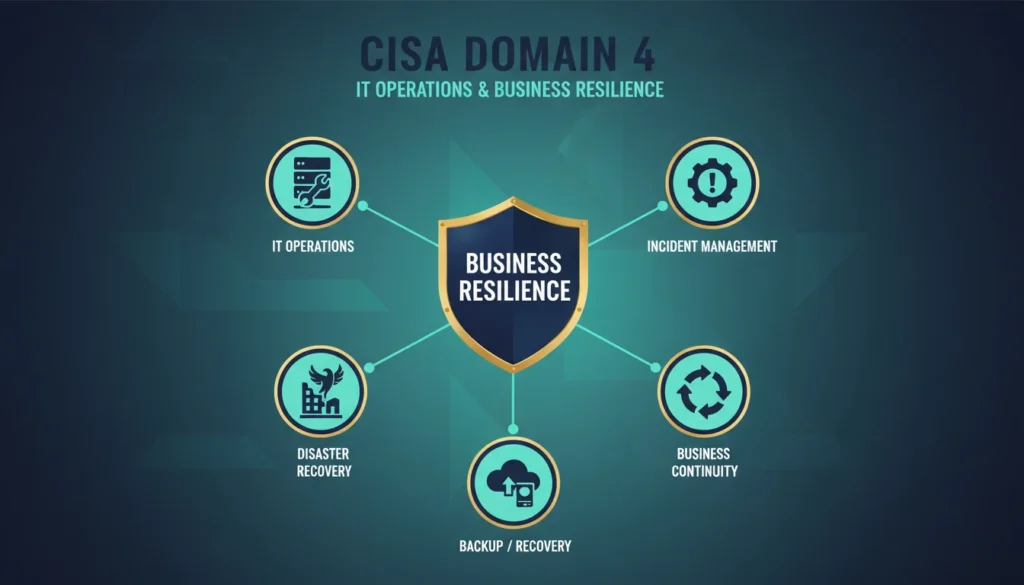
CISA Domain 4 · Business Resilience · Updated September 2026
📌 Quick Answer – Business Resilience in CISA Domain 4
Business resilience is the organization’s ability to continue critical business operations during and after a disruption, and to recover systems, data, people and facilities within acceptable business requirements. For a CISA auditor, the real question is not “Is there a plan?” but “Can the organization prove it can recover within its defined objectives?”
🔑 Key Takeaways
- BIA is business-driven: it decides what is critical and how fast it must come back.
- RPO = data loss, RTO = recovery time, MTTR ≠ RTO.
- Backup is not recovery: only a tested restore proves recoverability.
- BCP is broader than DRP; resilience is broader than disaster recovery.
- Evidence beats statements: an untested plan gives limited assurance.
For a CISA auditor, the question is not simply: “Does the organization have a Business Continuity Plan?” The more important questions are:
- Has the organization identified what is actually critical?
- Has it assessed the impact of disruption?
- Are recovery objectives based on business requirements?
- Are backup and recovery mechanisms adequate?
- Are alternative processing arrangements available where required?
- Has the BCP/DRP actually been tested?
- Can the organization demonstrate that it can recover within its defined objectives?
- Are identified weaknesses corrected and followed up?
Business Impact Analysis (BIA)
What Is a BIA?
A Business Impact Analysis (BIA) identifies the organization’s critical business processes and determines the consequences of their disruption. The BIA answers questions such as:
- Which business processes are critical?
- What happens if a process becomes unavailable?
- How long can the organization tolerate the disruption?
- What systems, applications, data, people and facilities are required to operate the process?
- What is the financial, operational, legal, regulatory or reputational impact?
- What recovery priority should be assigned?
The BIA is therefore a business-oriented analysis, rather than simply a technical analysis.
💡 Example: Online Banking
Suppose an online banking system becomes unavailable. The BIA should not only ask “How quickly can the server be restored?” It should first determine: “How long can the bank’s business tolerate the service being unavailable?”
BIA and Risk Assessment Are Different
These concepts are frequently confused.
| Risk Assessment | Business Impact Analysis |
|---|---|
| Identifies threats, vulnerabilities and risks | Identifies consequences of business disruption |
| Focuses on likelihood and impact of risks | Focuses on impact of loss/unavailability |
| Asks “What can go wrong?” | Asks “What happens if this process is unavailable?” |
| Helps determine risk treatment | Helps determine recovery priorities and requirements |
| Often threat/risk oriented | Primarily business/process oriented |
🧠 Memory Aid
Risk Assessment → What could happen?
BIA → What would be the business consequence?
Classification of Business Operations – Business Resilience in CISA Domain 4
Not every business process has the same recovery priority. A BIA normally classifies processes according to their criticality. For example:
| Classification | Meaning | Example |
|---|---|---|
| Mission-critical | Failure can seriously threaten the organization’s survival or essential mission | Core banking transactions |
| Critical | Must be restored quickly to avoid serious business consequences | Payroll, customer services |
| Important | Temporary disruption is tolerable but should be recovered within a defined period | Management reporting |
| Non-critical | Can tolerate a relatively long interruption | Some administrative activities |
The exact classification terminology varies between organizations.
🔍 Auditor’s Perspective
The auditor should determine whether:
- classification criteria are formally defined;
- criticality is approved by business management;
- critical systems are linked to critical business processes;
- dependencies have been identified;
- classifications are periodically reviewed;
- recovery priorities are consistent with business requirements.
A common audit weakness is a technically detailed DR plan that does not clearly establish which business processes are actually critical.
Dependencies in a BIA
A business process rarely operates independently. For example, an online sales process may depend on:
Customer → Website → Application → Database → Network → Cloud provider → Internet → Payment gateway → Staff
If one critical dependency is ignored, the recovery plan may fail even though the primary application has been restored. The BIA should therefore consider dependencies such as:
applications databases network infrastructure telecommunications cloud services third-party providers facilities power personnel suppliers data authentication services
🔍 Audit Focus
An auditor should verify whether critical dependencies identified during the BIA are reflected in the BCP and DRP.
Recovery Objectives: RPO, RTO and MTTR
Several terms are especially important for the CISA examination.
Recovery Point Objective (RPO)
RPO defines the maximum acceptable amount of data loss measured in time. For example, RPO = 4 hours means that, following a disruption, the organization is prepared to potentially lose up to four hours of data. RPO therefore influences:
backup frequency replication frequency synchronization mechanisms recovery architecture
🧠 Remember
RPO = How much data can we afford to lose?
Recovery Time Objective (RTO)
RTO defines the target time within which a business process or system should be restored after disruption. For example, RTO = 2 hours means the organization has established a requirement to restore the service within two hours.
🧠 Remember
RTO = How quickly must we recover?
Mean Time to Repair (MTTR)
MTTR is the average time required to repair or restore a failed system or component. It is primarily an operational/performance measure. RTO is a business recovery requirement, whereas MTTR is generally a performance/operational measure.
| Metric | Key Question |
|---|---|
| RPO | How much data can we lose? |
| RTO | How quickly must we recover? |
| MTTR | How long does it normally take to repair/restore? |
🎯 Important Exam Point
An organization’s normal MTTR being longer than its RTO indicates a potential recovery capability problem.
System and Operational Resilience
Resilience is broader than disaster recovery. Resilience is the ability of systems and operations to continue delivering required services despite disruption or failure. A resilient environment attempts to prevent or minimize interruption, rather than simply recovering after failure.
Resilience vs Recovery
| Resilience | Disaster Recovery |
|---|---|
| Focuses on continuing operations | Focuses on restoring operations |
| Attempts to minimize interruption | Activated when disruption requires recovery |
| Often uses redundancy/failover | Uses recovery facilities, backups and DR procedures |
| Primarily proactive | Primarily recovery-oriented |
A resilient system may automatically fail over to another server when one server fails. A DR process may be required when an entire data center is unavailable.
Recovery Strategies and Alternatives
The recovery strategy should be consistent with:
business criticality RTO RPO cost risk regulatory requirements technical dependencies
Common recovery alternatives include:
| Site Type | Description | Advantages | Disadvantages |
|---|---|---|---|
| 🔥 Hot Site | A fully or substantially equipped alternative facility that can support rapid recovery. | ✅ Very short recovery time ✅ Infrastructure is already available ✅ Suitable for highly critical operations |
⚠️ Expensive ⚠️ Requires ongoing maintenance and synchronization |
| 🌤️ Warm Site | A facility with some infrastructure available, but requiring additional configuration, restoration, or preparation before operations can resume. | ✅ Balance between cost and recovery speed ✅ Faster recovery than a cold site |
⚠️ Requires additional configuration and preparation ⚠️ More expensive than a cold site |
| ❄️ Cold Site | A facility providing basic infrastructure such as space, power, and environmental support, but systems and data generally need to be installed or restored. | ✅ Lower cost ✅ Basic facilities are readily available |
⚠️ Longer recovery time ⚠️ Significant installation and restoration work may be required |
Reciprocal Agreement
Two organizations may agree to provide facilities/resources to each other during a disaster. Such arrangements can introduce concerns about:
capacity compatibility security availability contractual enforceability simultaneous disasters
Cloud-Based Recovery
Cloud infrastructure may be used to provide replicated systems, backup storage, virtual infrastructure, disaster recovery environments and geographically distributed recovery capabilities.
The auditor should not assume that “cloud” automatically means resilient. The organization still needs to assess:
provider availability geographic redundancy contractual commitments security data recovery RTO/RPO achievement provider dependency
Data Backup, Storage and Restoration
Backups are one of the fundamental components of recoverability. A backup strategy should address:
- what is backed up, when, and how frequently;
- where it is stored and how long it is retained;
- how it is protected and who can access it;
- how restoration is performed and how restoration is tested.
The existence of backups alone does not prove recoverability. The organization must demonstrate that backups can actually be restored.
Backup Types: Full vs Incremental vs Differential
| Feature | Full | Incremental | Differential |
|---|---|---|---|
| Copies | All selected data | Changes since previous backup | Changes since last full backup |
| Backup time | Highest | Lowest | Moderate |
| Storage requirement | Highest | Lowest | Increasing each day |
| Restoration | Simplest | More complex | Easier than incremental |
| Typical restore requirement | Full | Full + required increments | Full + latest differential |
🧠 CISA Exam Memory Aid
Incremental → previous backup
Differential → last full backup
Backup Schemes and Rotation
Backup rotation determines how backup media or backup sets are reused and retained. A rotation strategy may include daily backups, weekly full backups, monthly archival backups, offsite copies and long-term retention. The purpose is to ensure that:
- historical recovery points are available;
- media is not unnecessarily reused;
- backups survive local disasters;
- retention requirements are satisfied.
The auditor should evaluate whether the rotation schedule is consistent with RPO, retention requirements, legal/regulatory requirements, business needs and available storage.
Backup Security
Backups contain valuable organizational information and must be protected like production data.
⚠️ Ransomware and Backups
If attackers can compromise production systems and then delete or encrypt connected backups, the organization’s recovery capability may be seriously affected. Backup architecture should therefore consider isolation and protection against unauthorized modification or deletion.
Offsite Backup
Keeping backup copies at the same location as production systems creates a major risk. For example: fire destroys the primary data center and all backup media stored inside it. Therefore, critical backups should generally have geographically separate copies. The auditor should examine:
physical location environmental protection access controls transportation controls encryption media inventory chain of custody retention restoration capability
🎯 Important Principle
Backup is not the same as recovery. A backup that cannot be restored is not an effective recovery control.
Cloud Backup
Cloud backup involves storing backup data with a cloud service provider. Potential benefits include geographic separation, scalable storage, automation, reduced infrastructure requirements and potentially faster deployment. However, the auditor should consider:
provider availability data location encryption access management contractual requirements retention recovery costs bandwidth limitations restoration time provider lock-in security of backup credentials testing of restoration
The auditor should verify that the cloud backup arrangement can actually satisfy the organization’s RTO and RPO.
Backup Devices and Media
Backup technologies may include magnetic tape, disk-based backup, removable media, network-attached storage, cloud storage, object storage and replication to another data center.
The technology itself is less important than whether it satisfies business requirements. The auditor should consider reliability, capacity, performance, security, compatibility, retention, recoverability and environmental protection. For removable media, physical security and media degradation are particularly important.
Business Continuity Planning (BCP)
A Business Continuity Plan (BCP) defines how an organization will continue or resume critical business activities when a disruptive event occurs. BCP is broader than IT disaster recovery.
BCP vs DRP
| BCP | DRP |
|---|---|
| Broad business perspective | Primarily recovery of IT/information systems |
| Focuses on continuity of business operations | Focuses on restoration of technology/services |
| Includes people, facilities, processes and suppliers | Includes systems, infrastructure, networks and data |
| Business-driven | Technically focused, but derived from business requirements |
A DRP should support the BCP rather than operate independently.
Typical BCP Process
A logical BCP lifecycle can be represented as:
Business requirements → Risk assessment → BIA → Recovery objectives → Recovery strategies → Plan development → Testing → Maintenance → Continuous improvement
- Establish planning scope. Determine organizational scope, critical functions, stakeholders, responsibilities and assumptions.
- Perform risk assessment. Identify threats and vulnerabilities that could disrupt operations.
- Perform BIA. Determine critical processes, impact, dependencies, recovery priorities, RTO and RPO.
- Develop recovery strategies. Select appropriate alternatives based on business requirements.
- Develop the BCP. Document roles, responsibilities, communication procedures, recovery procedures, escalation, emergency contacts, alternate facilities and supplier arrangements.
- Test the plan. Testing determines whether the documented plan actually works.
- Maintain and update. Plans must be updated when there are changes to systems, applications, business processes, personnel, suppliers, facilities, regulations or organizational structure.
A BCP policy establishes management’s commitment and direction for business continuity. The policy should be approved by appropriate management.
🔍 Auditor’s Focus
Do not merely verify that a policy exists. Determine whether Policy → Plans → Procedures → Testing → Evidence are consistent. A beautifully written policy with no evidence of implementation is a weak control environment.
Crisis Communication
A disaster may create reputational damage even when systems are eventually restored. BCP should therefore consider:
crisis communication customer notification media communication regulatory notification stakeholder communication designated spokespersons escalation procedures
The organization should avoid having different departments provide contradictory information during a crisis.
BCP Testing
Testing is essential because documentation alone does not demonstrate preparedness. A BCP test can identify outdated contact information, missing responsibilities, unrealistic recovery times, unavailable resources, communication problems, dependency failures and inadequate backup arrangements.
BCP Testing Methods
| Test | Realism | Risk | Typical Purpose |
|---|---|---|---|
| Checklist / document review | Low | Very low | Validate documentation |
| Tabletop / walkthrough | Moderate | Low | Validate roles and decisions |
| Simulation | Moderate–High | Moderate | Validate procedures |
| Parallel test | High | Lower than full interruption | Validate recovery capability |
| Full interruption | Very high | High | Demonstrate actual recovery |
🎯 Important Audit Principle
A plan that has never been tested provides limited assurance that the organization can actually recover.
Good BCP Practices
management sponsorship clearly defined responsibilities current contact information documented critical processes BIA-driven priorities defined RTO/RPO documented dependencies alternate processing arrangements tested communication procedures tested backup restoration periodic testing lessons learned plan maintenance staff awareness and training integration with incident management
BCP should not be treated as a one-time project. It is a continuous lifecycle.
Auditing Business Continuity
A CISA auditor should assess whether business continuity controls are properly designed, implemented, maintained, tested, monitored and aligned with business requirements. The audit should start with the organization’s business requirements rather than simply reviewing the BCP document.
Key Audit Questions
| Area | Questions to Ask |
|---|---|
| Governance | Is there an approved BCP policy? Is management accountable? Are roles and responsibilities defined? |
| BIA | Has a BIA been performed? Are critical processes identified? Are dependencies documented? Are RTO/RPO requirements approved? |
| Recovery | Are recovery strategies aligned with business requirements? Are alternative facilities available where required? Are supplier dependencies addressed? |
| Backup | Are backups performed according to defined requirements? Are backups protected? Are offsite copies maintained? Are restoration procedures tested? |
| Testing | Is the BCP tested periodically? Are critical scenarios included? Are results documented? Are weaknesses tracked to closure? |
| Maintenance | Is the plan updated after major changes? Are lessons learned incorporated? |
Interviews and Corroborating Evidence
Interviews are an important audit evidence-gathering technique. The auditor should interview representatives from relevant areas, such as business process owners, IT management, infrastructure teams, information security, facilities, HR, communications, procurement, legal/compliance and third-party providers.
However, interview responses should be corroborated with evidence. For example, if management says “Backups are tested every month,” the auditor should seek supporting evidence such as:
backup logs restoration test reports test results incident records management review corrective action records
Interview evidence should be corroborated where appropriate.
Reviewing Alternative Processing Contracts
Organizations may rely on third parties for alternate processing facilities, cloud recovery, backup storage, telecommunications, managed infrastructure and disaster recovery services. The auditor should review contracts and service agreements to determine whether they address:
availability recovery requirements RTO/RPO security confidentiality data location responsibilities testing service levels termination audit rights contingency arrangements
The existence of a contract does not prove that the service will meet recovery requirements. Testing and evidence are still important.
Insurance Coverage
Organizations may purchase insurance related to business interruption, property damage or cyber incidents. The auditor may review whether coverage is consistent with identified risks. Insurance does not replace business continuity controls: it primarily transfers some financial risk; it does not restore systems or operations.
Disaster Recovery Plan (DRP)
A Disaster Recovery Plan provides procedures for recovering IT systems, infrastructure, applications and data after a disruptive event. A DRP may address:
disaster declaration recovery team activation communication infrastructure recovery network recovery application recovery database recovery data restoration system validation return to normal operations
The DRP should be aligned with the BIA and BCP.
DRP Recovery Priorities
Recovery should normally follow business priorities established through the BIA. For example:
Critical application → Supporting database → Authentication → Network → Dependent services
The exact sequence depends on system dependencies. A common audit issue is restoring an application before restoring one of its critical dependencies. Therefore, recovery plans should document technical dependencies and recovery sequencing.
Invoking the Disaster Recovery Plan
The DRP should define:
- who has authority to declare a disaster;
- what conditions trigger invocation;
- who activates recovery teams;
- communication procedures and escalation;
- alternate facility activation;
- supplier and management notification;
- regulatory notification where applicable.
The decision to invoke a DRP should not depend on an undefined “common sense” decision. Clearly defined authority and criteria reduce confusion during a crisis.
Disaster Recovery Testing
DRP testing should verify whether systems and infrastructure can actually be recovered within defined requirements. Testing should produce evidence such as test objectives, scenarios, participants, results, deviations, issues, lessons learned and corrective actions.
Recovery Testing: What Should the Auditor Look For?
| Defined Requirement | DR Test Result | Auditor’s Conclusion |
|---|---|---|
| RTO = 4 hours | System restored in 7 hours | ❌ Requirement not met, so this must be reported as a discrepancy |
| RPO = 1 hour | 6 hours of data lost | ❌ Recovery capability does not meet the business requirement |
The auditor should identify the discrepancy rather than simply recording “DR test completed successfully.” The important question is: Did the organization demonstrate that it can meet its defined recovery requirement?
End-to-End Business Resilience Model
For CISA examination purposes, it is useful to understand the relationship between all the concepts:
Business Processes
↓
Business Impact Analysis
↓
Criticality & Dependencies
↓
RTO / RPO
↓
Recovery Strategy
↓
BCP + DRP
↓
Backup / Replication / Alternate Facilities
↓
Testing
↓
Lessons Learned
↓
Plan Improvement
The auditor should be able to follow this chain. If the BIA says a process has an RTO of two hours, the recovery strategy, technology, backup arrangements and DR procedures should collectively support that requirement.
12 High-Value CISA Exam Reminders
- A BIA is business-driven. Do not confuse it with a technical disaster recovery assessment.
- RPO concerns data loss. RPO answers: How much data can we afford to lose?
- RTO concerns recovery time. RTO answers: How quickly must the service be restored?
- MTTR is not RTO. MTTR describes actual/operational repair performance; RTO is a business recovery requirement.
- Incremental and differential backups are different. Incremental = changes since the previous backup. Differential = changes since the last full backup.
- Backup does not equal recoverability. Restoration must be tested.
- BCP is broader than DRP. BCP focuses on continuing business operations; DRP primarily addresses technology recovery.
- Resilience is broader than disaster recovery. Resilience seeks to maintain service despite failures; DR focuses on recovery when disruption occurs.
- A plan that is not tested provides limited assurance.
- Recovery requirements should drive recovery solutions. Do not select a recovery technology first and then attempt to justify it.
- The auditor should verify evidence, not simply accept management statements.
- A successful test is not necessarily an effective test. The important question is whether the test demonstrated that defined business requirements, particularly RTO/RPO, can actually be achieved.
The Big Picture
The central idea behind Domain 4 is not disaster recovery technology. It is the relationship between business requirements, risk, recovery objectives, controls and evidence.
❓ The Question a CISA Auditor Should Always Ask
What does the business need to recover, how quickly does it need to recover, how much data can it afford to lose, what controls enable that recovery, and what evidence demonstrates that the controls actually work?
This mindset helps connect BIA, resilience, backups, BCP and DRP into one coherent audit perspective. The strongest CISA answers generally follow the same logic:
Business requirement → Risk/impact → Recovery objective → Appropriate control → Testing → Evidence → Continuous improvement