

Reviewed by Senior SOC Analyst / Security Operations Lead] · Updated July 2026
- A SOC analyst detects, analyzes, and responds to cyber threats in real time from a Security Operations Center.
- The role is structured into three tiers: Tier 1 (triage), Tier 2 (investigation & incident response), and Tier 3 (threat hunting & detection engineering).
- It is the most accessible entry point into cybersecurity — often achievable without a degree.
- US salaries commonly range from ~$55K (entry) to $130K+ (senior); the BLS median for information security analysts was $124,910 (May 2024).
- AI is augmenting, not replacing, the role.
What is a SOC Analyst? (Simple Definition)
A SOC analyst is a cybersecurity professional embedded within a Security Operations Center who monitors, detects, and responds to potential threats across networks, endpoints, and identities. In plain terms, they are the vigilant eyes on the digital frontline — often the first to spot and respond to an incident. The job is fundamentally about three things: detect, analyze, and respond.
What Is a Security Operations Center (SOC)?
A Security Operations Center (SOC) is the centralized “command and control” hub of an organization’s cyber defense. Its primary function is to detect, analyze, and respond to cybersecurity events—combining people, processes, and technology. Think of it as mission control: aggregating event data from across the enterprise’s IT infrastructure and manning the firewalls, systems, and networks 24/7.
Every organization that takes security seriously runs some version of a SOC — from Fortune 500 companies and federal agencies to hospitals, banks, and cloud providers. Many smaller organizations outsource this function to a Managed Security Service Provider (MSSP), which employs its own SOC analysts.
Where SOC Analysts Fit on the Blue Team
SOC analysts are blue team (defensive) professionals. Unlike a lone cybersecurity analyst who may be the only security person at a company, SOC analysts are normally part of a large, dedicated team acting as a continuous line of defense. They collaborate closely with incident responders, threat intelligence, and security engineering, each bringing distinct skills to a comprehensive defense strategy.
What Does a SOC Analyst Do? (Core Responsibilities)
A SOC analyst’s day-to-day work revolves around monitoring, triage, investigation, and response. Core responsibilities include:
- Monitoring security dashboards and SIEM consoles for alerts and anomalous activity across networks, endpoints, and cloud environments.
- Triaging alerts — determining whether each alert is a true positive or a false positive, and prioritizing by severity.
- Investigating suspicious behavior — correlating events across multiple data sources to understand the who, what, how, when, and where of an incident.
- Escalating confirmed threats to Tier 2 analysts or the incident response team.
- Executing containment actions such as isolating compromised endpoints or disabling compromised accounts.
- Documenting incidents and contributing to post-incident reviews that strengthen the organization’s security posture over time.
- Maintaining detection rules and staying current on the evolving threat landscape.
A recurring operational challenge is alert fatigue—Tier 1 work is high-volume and can feel repetitive. Understanding how false positives and false negatives undermine a SOC is a core skill; see our deep dive on false positives in the SOC.
A Day in the Life of a SOC Analyst
A typical shift begins with reviewing overnight alerts and checking threat intelligence feeds for new indicators of compromise, followed by a shift-handoff briefing on active investigations. SOC analysts typically work assigned shifts within a 24/7 coverage schedule — sometimes compressed into longer shifts (e.g., four 10-hour or three 12-hour days).
To make this concrete, in the 2024 Snowflake breach, threat actor UNC5537 used credentials stolen via infostealer malware to access customer accounts that lacked multi-factor authentication. A SOC analyst’s response would begin at Tier 1 with an alert on anomalous login behavior and escalate to Tier 2 for credential-compromise verification across SaaS platforms—a clear illustration of how tiered response works in practice.
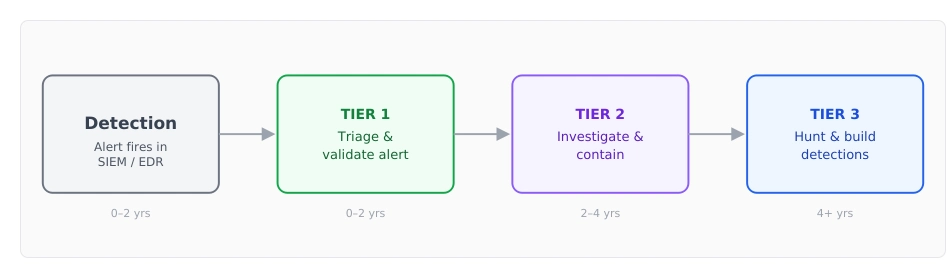
SOC Analyst Tiers: Tier 1 vs Tier 2 vs Tier 3
Most SOCs organize analysts into three tiers of increasing responsibility. (Some add a fourth tier for management.)
Tier 1 — Triage (Alert Monitoring)
Tier 1 analysts (SOC analyst l1) are the first line of defense and the most common entry point. They monitor dashboards and SIEM consoles, review incoming alerts, and make the initial determination of whether an alert is a true or false positive. Work centers on known indicators — malicious IPs, phishing signatures, and account-lockout patterns — with confirmed issues escalated to Tier 2. Typical experience: 0–2 years.
Tier 2 — Investigation & Incident Response
Tier 2 analysts take over when an alert needs deeper investigation. They correlate events across multiple data sources, perform root-cause analysis, and execute containment actions like isolating endpoints or disabling accounts. This tier turns raw Tier 1 telemetry into actionable intelligence and drives incident response. Typical experience: 2–4 years.
Tier 3 — Threat Hunting & Detection Engineering
Tier 3 analysts are the most experienced staff in a SOC. Rather than waiting for alerts, they proactively hunt for threats that bypass existing detections, build new detection rules, reverse-engineer malware, and mentor junior analysts. They handle major escalated incidents and often specialize in threat intelligence, malware analysis, or digital forensics. Typical experience: 4+ years.
Tier 4 — SOC Manager (Leadership)
Some organizations treat SOC managers/directors as a fourth tier. This is a leadership layer that oversees operations, defines SOC strategy, reports to stakeholders, and bridges technical work with business objectives—rather than “on-the-ground” analysis.
| Tier | Focus | Key tasks | Experience | Typical US salary |
|---|---|---|---|---|
| Tier 1 | Triage | Monitor alerts, initial triage, escalate | 0–2 yrs | ~$55K–$80K |
| Tier 2 | Investigation / IR | Deep dive, correlation, root cause, containment | 2–4 yrs | ~$75K–$100K |
| Tier 3 | Threat hunting | Proactive hunting, detection engineering, malware analysis | 4+ yrs | ~$100K–$150K |
| Tier 4 | Management | SOC strategy, team leadership, reporting | 6+ yrs | $120K+ |
Tools a SOC Analyst Uses (SIEM, EDR, SOAR & More)
SOC analysts are “human force multipliers” who verify and analyze alerts generated by automated tooling. The essential stack includes:
- SIEM (Security Information and Event Management): the backbone of the SOC—collects and correlates logs from across the enterprise and raises alerts. Common platforms: Splunk, IBM QRadar, Microsoft Sentinel, Wazuh, ArcSight, and Elastic Security.
- EDR (Endpoint Detection and Response): provides continuous endpoint visibility and response. Common tools: CrowdStrike Falcon, SentinelOne, and Microsoft Defender for Endpoint.
- SOAR (Security Orchestration, Automation and Response): automates repetitive tasks and response playbooks (e.g., Splunk SOAR, Palo Alto XSOAR, Tines). A SIEM detects → SOAR auto-triages low-severity alerts → humans handle high-severity escalations.
- Network & investigation tools: Wireshark (packet analysis), IDS/IPS, and reputation/enrichment services like VirusTotal and WHOIS.
- MITRE ATT&CK Framework: not a software tool but arguably the most important reference in modern detection and hunting — a globally accessible knowledge base of real-world adversary tactics, techniques, and procedures. Every SOC analyst should be fluent in it.
Skills You Need to Be a SOC Analyst
Technical skills
- Networking fundamentals: TCP/IP, DNS, DHCP, HTTP/S, firewalls, VPNs, routing/switching (you can’t read packet captures or spot anomalies without them).
- Operating systems: Windows (Active Directory, Event Logs, PowerShell) and Linux (CLI, syslog, permissions).
- Security fundamentals: the CIA triad, authentication, encryption, the OWASP Top 10, and the Cyber Kill Chain.
- Log analysis & SIEM/EDR fluency, plus familiarity with MITRE ATT&CK.
- Scripting (optional but valuable): Python, PowerShell, or Bash for automating routine tasks; SQL/Regex for querying logs.
Soft skills
- Analytical thinking — connecting disparate data points under pressure to identify threat patterns.
- Attention to detail—catching subtle anomalies tools miss.
- Clear communication—explaining technical findings to non-technical stakeholders and writing incident reports leadership can act on.
- Composure under pressure and strong documentation habits.
Lab Walkthrough: Investigating a Brute-Force Login Alert (Hands-On Example)
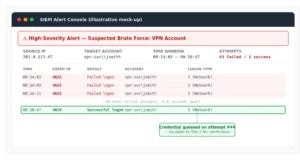
Original TheCyberSkills.com demo—the kind of portfolio evidence that gets you hired.
Scenario: Your SIEM (Splunk or Wazuh) fires an alert: 40+ failed logins to a VPN account from a single external IP within 5 minutes, followed by one success.
- Confirm it’s not a false positive. Check the rule logic and the source traffic pattern — is this a scanner, a locked-out user, or a real attack?
- Enrich the indicators. Run the source IP through reputation/threat-intel (VirusTotal, WHOIS). Is it a known-bad or Tor exit node?
- Correlate. Pull authentication logs (Windows Event IDs 4625 failed / 4624 success, logon type 3) and check whether other accounts or hosts show the same pattern—a single compromise vs. an active campaign.
- Map to MITRE ATT&CK. This aligns to T1110 (Brute Force) and, post-success, potential T1078 (Valid Accounts).
- Decide & contain. If confirmed, disable the account, force a password reset, and — if lateral movement is suspected — isolate the host and escalate to Tier 2.
- Document. Record the timeline, evidence, verdict, and remediation so others can build on it.
Frame lab work like this on your résumé: “Investigated a simulated brute-force attack in Splunk; enriched IOCs, mapped to MITRE ATT&CK, isolated the affected host, and wrote an incident report.” Employers want to see you can think through a security event—not just list tools. Practice on TryHackMe, Blue Team Labs Online, or CyberDefenders.
SOC Analyst Salary (2026)
SOC analyst pay scales with tier, location, industry, and certifications. As a benchmark, the U.S. Bureau of Labor Statistics reports a median annual wage of $124,910 for information security analysts (May 2024), with the lowest 10% under $69,660 and the highest 10% above $186,420.
Role-specific data shows a broad range — one industry guide cites $75K–$137K depending on experience and tier. Pay tends to be higher in finance, healthcare, and government and in major tech hubs (SF, NYC, DC), which can pay 20–40% above average. GIAC certifications can add $10K–$20K to an offer.
| Level | Typical US salary range |
|---|---|
| Entry-level (Tier 1) | $55,000 – $80,000 |
| Mid-level (Tier 2) | $75,000 – $100,000 |
| Senior (Tier 3) | $100,000 – $150,000 |
| SOC Manager | $120,000+ |
Salaries vary by region.
How to Become a SOC Analyst (Step-by-Step)
The SOC analyst role is one of the most accessible entry points in cybersecurity, and most people become job-ready in 6–12 months of focused preparation.
- Build IT & security fundamentals — networking, Windows/Linux, and core security concepts (CIA triad, kill chain).
- Earn a foundational certification (see below).
- Get hands-on in a home lab—spin up a VM lab with a SIEM ingesting logs; practice on TryHackMe/BTLO/CyberDefenders.
- Build a portfolio — document 3–5 investigations as professional write-ups (scenario → steps → findings → verdict) on GitHub.
- Apply strategically — target MSSP Tier 1 roles, security-focused help-desk roles, and entry-level SOC positions.
Certifications That Matter for SOC Analyst Jobs
- CompTIA Security+—the most widely required baseline cert and the gold-standard entry point (DoD 8570/8140 approved).
- CompTIA CySA+ — the certification most directly aligned with analyst work (behavioral analytics, threat intel, log analysis, incident response). Candidates with both Security+ and CySA+ are notably more competitive.
- EC-Council CSA (Certified SOC Analyst) — purpose-built for SOC operations, SIEM usage, and detection workflows; well-regarded at many MSSPs.
- Microsoft SC-200 (Security Operations Analyst) — increasingly expected in Microsoft-heavy enterprises (Sentinel, Defender, Azure).
- GIAC GCIH / GCIA and, later, CISSP for senior/leadership roles.
Build a Home Lab (Free)
A practical starter lab: a VM running Kali Linux, a SIEM (Wazuh or Splunk free tier) receiving logs from a small practice network, and guided investigations. Structured browser labs like TryHackMe’s SOC Level 1 path cover SIEM fundamentals, phishing analysis, endpoint security, and forensics with no setup.
Do You Need a Degree?
No. While a degree in computer science, IT, or cybersecurity helps, most employers prioritize certifications, hands-on skills, and relevant experience. One staffing firm reports that ~40% of the SOC analysts it placed in 2025 had no four-year degree—though some federal contractors and healthcare payers still require one contractually.
SOC Analyst vs Cybersecurity Analyst vs Incident Responder
These titles overlap and vary by company, but the core distinction is operational monitoring vs. broader planning/response.
| Role | Primary focus | Team context | Typical entry path |
|---|---|---|---|
| SOC Analyst | Real-time monitoring, triage, detection & response | Part of a large 24/7 SOC team | Security+ / CySA+ + labs |
| Cybersecurity / Security Analyst | Broader posture: risk, policy, vulnerability management, planning | May be the only security person; less shift-based | Similar certs; more policy/risk emphasis |
| Incident Responder | Containment, eradication, recovery & forensics of confirmed incidents | Works with/after the SOC | GCIH/GCFA; SOC experience first |
In short: SOC analysts detect and escalate; incident responders handle containment and recovery; cybersecurity analysts emphasize prevention and planning. SOC experience is one of the strongest springboards into all of them, as well as into threat intelligence, cloud security, and security engineering. Explore related roles in our top cybersecurity specialist jobs guide.
Will AI Replace SOC Analysts in 2026?
Short answer: no — AI is augmenting the role, not eliminating it. Routine Tier 1 triage is increasingly automated, while demand grows for analysts who can supervise AI, hunt threats, and handle complex investigations. SOC teams process enormous alert volumes daily, and AI-assisted triage helps counter two persistent problems: alert overload and burnout. The takeaway for aspiring analysts: build investigation, threat-hunting, and AI-collaboration skills, not just tool-operation skills.
Is SOC Analyst a Good Career?
Yes — it’s one of the strongest, most stable entry points in tech. The BLS projects 29% growth for information security analysts from 2024 to 2034 — roughly seven times the average for all occupations — with about 16,000 annual openings. SOC analyst roles specifically have grown ~31% year-over-year, and the (ISC)² 2025 Workforce Study reports a 4.8 million global workforce gap, with 59% of organizations reporting critical skills gaps (up from 44% the year prior). Demand, salary, and clear progression (Tier 1 → Tier 2 → Tier 3 → engineering/leadership) make it a durable career choice.
- A SOC analyst monitors, detects, investigates, and responds to cyber threats inside a Security Operations Center.
- The role spans three tiers — triage, investigation/IR, and threat hunting — with clear salary and skill progression.
- SIEM, EDR, SOAR, and MITRE ATT&CK are the core of the toolkit.
- You can enter without a degree via Security+/CySA+, a home lab, and a documented investigation portfolio.
- It’s a high-demand, well-paid, future-proof career — and AI augments rather than replaces it.
Frequently Asked Questions
What is a SOC analyst in simple terms?
What are the three tiers of SOC analysts?
What tools does a SOC analyst use?
How much does a SOC analyst make?
Do you need a degree to be a SOC analyst?
How long does it take to become a SOC analyst?
Is SOC analyst an entry-level job?
Will AI replace SOC analysts?
Sources: U.S. Bureau of Labor Statistics; (ISC)² Cybersecurity Workforce Study; CyberSeek; MITRE ATT&CK; vendor and training references. Last updated July 2026.
For further study on the subject, please visit https://thecyberskills.com/

