Most people who fail the ISC2 CC or stall halfway through CISSP prep don’t fail because the material is too hard. They fail because they memorized definitions such as confidentiality, least privilege, and non-repudiation without ever connecting them to how an actual attack unfolds.
This guide walks through the concepts that sit underneath both exams: threats, vulnerabilities, and risk; the CIA triad and its evil twin, the DAD triad; AAA services; and the protection mechanisms such as defense in depth, abstraction, data hiding, and encryption on which ISC2’s Domain 1 (Security Principles) and Domain 3 (Access Controls Concepts) are built around. Every definition here comes with a real example, because that’s the only way these ideas actually stick.
What is Cybersecurity, Really?
Cybersecurity is the practice of protecting systems, networks (network security), devices, applications, and data from unauthorized access, damage, disruption, or theft. That’s the textbook version. In practice, it’s a mix of technology, processes, policy, and plain human habit, and all four have to work together, because a strong firewall does nothing if it is not configured properly or every employee is logged in as administrator.

NIST puts it more formally as the prevention of damage to, and restoration of, computer and communication systems in order to protect their availability, integrity, authentication, confidentiality, and non-repudiation. That single sentence quietly contains the entire structure of this article, so it’s worth reading twice.
The whole field exists to protect three things, and only three things. They’re known together as the CIA triad, and almost every control, policy, and exam question eventually traces back to one of them.
A Cyber Attack, Defined Properly
A cyber attack is a deliberate, malicious act aimed at compromising a system, network, device, application, or dataset. The motive varies: theft, sabotage, extortion, and espionage, but the act is always intentional. That intent is what separates an “attack” from an accident; a misconfigured server isn’t an attack, but someone exploiting that misconfiguration is.
Threats, Vulnerabilities, and Risk: and Why Beginners Mix Them Up
These three words get used almost interchangeably outside cybersecurity. Inside it, they describe three completely different things, and the CC exam loves testing whether you actually know the difference.
| Term | What it actually means | Real-world example |
|---|---|---|
| Threat | Anything with the potential to cause harm can be a person, event, or condition. Not always human. | Malware, a phishing email, a power outage, a flood, a hardware failure |
| Threat Actor | The specific person or group behind a deliberate, intentional threat. | A hacker, a ransomware gang, a nation-state group, a malicious insider |
| Vulnerability | A weakness that a threat can exploit. | An outdated plugin, a reused password, a misconfigured S3 bucket |
| Attack Vector | The path the attacker actually takes to reach the vulnerability. | A phishing link, an exposed RDP port, an infected attachment |
| Risk | The likelihood a threat exploits a vulnerability, combined with the resulting damage. | “There’s a high chance this unpatched server gets breached, and it would cost us $200K if it did.” |
Risk Management: Reducing Risk, Not Eliminating it
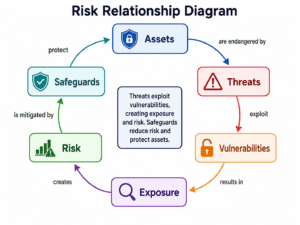
Risk management is the structured process of identifying valuable assets, working out what could damage them, and deciding which of those problems are worth fixing first. The goal is not, and cannot be, a zero-risk environment. A bank, a hospital, and a five-page blog all have wildly different definitions of “acceptable risk,” and a control that costs more than the asset it protects rarely survives a budget conversation.
It breaks down into two halves. Risk assessment identifies risks, estimates how likely each one is, and ranks them by potential damage. Risk response then picks how to handle each one: reduce it, accept it, avoid it, or transfer it (insurance is the classic example of transfer). This isn’t a one-off exercise: new technology, new threats, and new regulations mean the cycle repeats continuously.
The CIA Triad: Confidentiality, Integrity, Availability
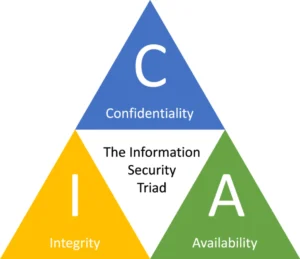
Every control you’ll study for the CC or CISSP exam ultimately protects one (or more) of three things. Get comfortable separating them, because exam questions are designed to test exactly that separation.
Confidentiality — Keeping Secrets Secret
Confidentiality means only authorized people, systems, or processes can see a given piece of information. It doesn’t mean locking everyone out—it means making sure the right people get in and nobody else does. Most confidentiality failures, contrary to what the headlines suggest, aren’t sophisticated hacks at all. They’re an employee CC’ing the wrong person, a cloud storage bucket left public by mistake, or a password weak enough to be guessed.
It’s protected through encryption, access control, strong authentication (MFA and biometrics included), data classification, and plain staff training. A hospital that encrypts patient files, restricts access to authorized clinicians, and trains its staff on data handling is applying confidentiality controls in three different layers at once.
Integrity — Keeping Data Honest
Integrity means data stays accurate and unaltered unless someone with proper authority changes it, and even then, the change should be logged. There are really three angles to this: stopping outsiders from tampering with data, stopping insiders from making changes outside their role, and simply making sure data reflects reality. If a payment was 10,000 rupees, the system should never silently show 1,000 or 100,000.
Integrity failures aren’t always attacks either: a coding bug, a careless overwrite, or a misconfigured permission can corrupt data just as effectively as a hacker can. It’s typically protected through hash verification, digital signatures, input validation, change control processes, and intrusion detection.
Availability — Keeping the Lights On
Availability means authorized users can actually get to the systems and data they need when they need them. Secret, accurate data that nobody can reach during an emergency is useless: ask any hospital that’s had its system go down mid-shift. Availability is threatened by hardware failure, software bugs, power loss, environmental damage, denial-of-service attacks, and ordinary human error, and it’s protected through backups, redundancy, fault tolerance, monitoring, and business continuity and disaster recovery planning.
A central idea here is to identify and address the single point of failure — one component that, if it fails, takes the entire service down with it.
The three parts of the triad lean on each other constantly. Weak access control can let an unauthorized user damage availability; broken integrity means even available data can’t be trusted. Treat the CIA triad as one system, not three separate checklists.
The DAD Triad: What It Looks Like When Security Fails
If CIA describes the goal, DAD describes the failure mode. DAD stands for Disclosure, Alteration, and Destruction, and each one maps directly onto a broken pillar of the CIA triad. Disclosure is a confidentiality failure: sensitive data seen by someone unauthorized. Alteration is an integrity failure: data changed without permission. Destruction is an availability failure: data or systems damaged, deleted, or made unreachable.
Authenticity, Non-Repudiation, and the AAA Chain
Once you’ve got the CIA and DAD down, the next layer is about proving identity and accountability—who really sent this, and can they later deny having done it?
Authenticity vs Integrity—A Subtle but Important Difference
Authenticity asks: did this really come from who it claims to come from? Integrity asks a related but different question: has this been changed since it was sent? An email that looks like it’s from your bank but isn’t is an authenticity failure, regardless of whether its content was tampered with. Authenticity is typically backed by digital certificates, digital signatures, and strong login systems.
Non-Repudiation — Proving Who Did It
Non-repudiation means a person or system can’t later deny having taken an action. It matters because accountability collapses without it—if a manager can credibly claim “I never approved that payment,” the organisation has no way to assign responsibility. Non-repudiation is built from a chain: identification, authentication, authorization, auditing, and accountability, all working together.
The Five-Step AAA Chain
AAA is usually shorthand for Authentication, Authorization, and Accounting—but it’s easier to learn as a five-step sequence, because each step depends on the one before it.
| Step | What it does | Everyday example |
|---|---|---|
| Identification | Claiming an identity. | Typing your username on a login screen. |
| Authentication | Proving that the claimed identity is real. | Entering your password or a one-time code. |
| Authorization | Deciding what the authenticated user can do. | A WordPress author can publish posts but can’t install plugins. |
| Auditing | Recording what was done for later review. | A log shows which admin account edited a plugin file at midnight. |
| Accountability | Holding the identified user responsible for their actions. | Reviewing logs to confirm who approved a suspicious transaction. |
One distinction that trips people up on the exam: monitoring is watching activity as it happens, while auditing is recording it so it can be reviewed afterward. Watching versus recording — that’s the whole difference.
Four Protection Mechanisms Behind Every Security Control
Controls don’t all work the same way. Some add layers, some simplify management, some hide things from people who shouldn’t see them, and some scramble data outright. The CC exam expects you to know all four mechanisms by name.
Defense in Depth
Defense in depth means stacking multiple independent controls instead of relying on any single one. Think of a house with a gate, a locked door, a camera, and an alarm — if a burglar gets past the gate, three more obstacles still stand in their way. A WordPress site with a strong admin password, two-factor authentication, a web application firewall, regular backups, and up-to-date plugins is practicing defense in depth across five separate layers.
Abstraction
Abstraction simplifies security by managing groups, roles, or classes instead of individuals one at a time. Rather than configuring permissions for every employee by hand, an organisation defines roles—HR, Finance, IT Admin—and assigns access to the role rather than the person.
Data Hiding
“Data hiding” means a user has no path to reach certain data at all—not that the data is merely unlabelled or hard to find. This is an important distinction from security through obscurity, which just hopes attackers won’t stumble across something. Hoping nobody finds the folder is obscurity. Enforcing real access control so the folder is unreachable without authorization is data hiding.
Encryption
Encryption converts readable plaintext into unreadable ciphertext so that even if an attacker intercepts the data, they can’t read it without the key. HTTPS, encrypted backups, and encrypted messaging apps all lean on this same principle. It’s the primary mechanism for protecting confidentiality specifically—it does nothing to stop an attack from happening, but it makes the stolen data worthless without the decryption key.
Least Privilege, Need to Know, and Separation of Duties
These three access-control principles often get tested together because they’re easy to confuse but solve slightly different problems.
Least privilege limits permissions to the minimum needed for a job—a receptionist has no business holding network admin rights, and not every WordPress contributor needs to be made an administrator just because it’s convenient. Need to know is closely related but governs information access rather than system permissions: an employee in the same company doesn’t automatically need to see salary records or legal files just because they technically could. Separation of duties splits a sensitive process across two people so no single person controls it end-to-end—one person requests a payment, a different person approves it; one developer writes code, another reviews and deploys it.
Hashing vs Encryption: The Mix-Up That Costs Exam Points
Hashing converts data into a fixed-size value — a kind of digital fingerprint — using a one-way mathematical function. Change the original data even slightly, and the hash value changes completely. It’s used to verify downloaded files, store passwords safely, and detect file tampering. Crucially, hashing is not designed to be reversed.
Encryption, on the other hand, is reversible by design — that’s the entire point. Give someone the right key, and ciphertext turns back into plaintext. The two solve different problems entirely, and conflating them is one of the most common mistakes beginners make on practice exams.
| Feature | Hashing | Encryption |
|---|---|---|
| Main purpose | Verify integrity | Protect confidentiality |
| Reversible? | No | Yes, with the correct key |
| Output | Fixed-length hash value | Ciphertext |
| Common example | Password hash, file checksum | Encrypted email, encrypted hard drive |
Patch Management and Incident Response

Patch management is the discipline of regularly updating software, operating systems, firmware, and plugins to close known vulnerabilities before attackers find them first. This sounds mundane, but a huge share of real-world breaches trace back to a patch that was simply never applied. If a WordPress plugin has a publicly known vulnerability and the site owner never updates it, that vulnerability sits there as an open invitation.
Incident response is the organised process for detecting, containing, eradicating, recovering from, and learning from security incidents such as malware infections, breaches, ransomware, defacement, or insider misuse. A functioning incident response plan defines clear roles, an escalation path, evidence preservation steps, and a post-incident review so the same mistake isn’t repeated. ISC2’s Domain 2 covers this lifecycle alongside business continuity and disaster recovery planning, and the three concepts are tested together because they describe the same continuum: prepare, survive the disruption, recover, then formally close the loop.
Why Security Awareness Training Still Matters Most
Technical controls can be flawless and still get bypassed by one tired employee clicking the wrong link. Security awareness training exists because people remain the most exploited “attack surface” in any organization: covering phishing recognition, password hygiene, MFA adoption, safe downloading habits, and how to actually report something suspicious rather than quietly ignoring it.
A Five-Question Framework for Any Cybersecurity Scenario
When a CC or CISSP exam question feels overwhelming, strip it down to five questions. This works for almost any scenario-based item you’ll face.
- Asset — What actually needs protecting?
- Threat — What could cause harm to it?
- Vulnerability — What weakness could be exploited?
- Risk — What’s the realistic damage if it happens?
- Control — What reduces that risk to an acceptable level?
Beginner Checklist and Common Mistakes
| Do this | Avoid this common mistake |
|---|---|
| Use strong, unique passwords with MFA enabled | Reusing the same weak password everywhere |
| Patch software on a regular schedule | Ignoring update notifications for months |
| Limit administrator access to those who truly need it | Making every user an admin “to save time” |
| Keep tested, working backups | Assuming antivirus alone is sufficient protection |
| Train users to recognise phishing attempts | Confusing hashing with encryption on the exam |
| Maintain a written incident response plan | Leaving unused plugins, themes, and old accounts active |
Conclusion
None of this is meant to be memorised in isolation. Threats exploit vulnerabilities; risk management decides what gets fixed first; the CIA triad defines what’s worth protecting; defense in depth, least privilege, and separation of duties cut down who can do damage and how far it spreads; hashing and encryption protect different things for different reasons; and incident response cleans up when, inevitably, something still goes wrong.
That’s the actual shape of Domain 1 and Domain 3 of the ISC2 CC exam, and it’s also the actual shape of how cybersecurity teams think on the job. Once the pattern clicks, ethical hacking, SOC analysis, cloud security, and digital forensics stop looking like separate subjects—they’re just this same logic applied to different environments.
- A threat causes harm, a vulnerability is exploitable, and risk is the likelihood-times-impact of the two meeting.
- The CIA triad — confidentiality, integrity, availability — is the goal; the DAD triad — disclosure, alteration, destruction — is what it looks like when each pillar fails.
- The AAA chain (identification → authentication → authorization → auditing → accountability) is how systems prove who did what and hold them to it.
- Defense in depth, least privilege, and separation of duties all reduce blast radius—they limit how far a single failure can spread.
- Hashing verifies integrity and is one-way; encryption protects confidentiality and is reversible with the correct key.
- Patch management closes known gaps before attackers find them; incident response minimises damage when something gets through anyway.
What to Study Next
Once these fundamentals feel solid, the natural next steps are the CIA triad applied specifically to cloud environments and a broader survey of the cyber threat landscape most organisations face in 2026.
Frequently Asked Questions
What are the fundamental concepts in cyber security?
What is the CIA triad?
In cybersecurity, what is the difference between a threat, a vulnerability, and risk?
What is defense in depth?
What is the principle of least privilege?
What is the difference between authentication and authorization?
What is the difference between hashing and encryption?
Why is patch management important?
What is incident response?
Why does security awareness training matter so much?
References
| # | Source | Description / URL |
|---|---|---|
| 1 | NIST CSRC | Official Glossary Definition — Cybersecurity |
| 2 | NIST CSRC | Official Glossary Definition — Cyber Attack |
| 3 | ISC2 | Certified in Cybersecurity (CC) — Official Certification Page |
| 4 | ISC2 | ISC2 One Million Certified in Cybersecurity Program |
| 5 | NIST SP 800-53 | Security and Privacy Controls for Information Systems and Organizations |
| 6 | NIST | NIST Cybersecurity Framework (CSF) |
| 7 | ISC2 | ISC2 Code of Ethics |
https://thecyberskills.com/category/learn-train/