
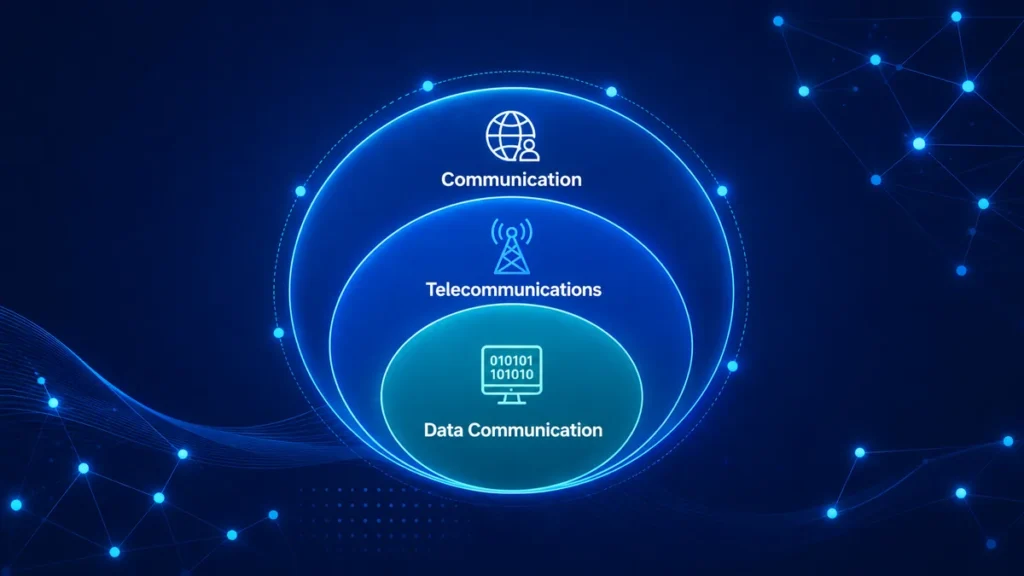
These three terms are frequently used interchangeably in everyday speech, but in computer science and engineering they carry precise and distinct meanings. Understanding the difference between communication and telecommunication, telecommunications and data communication is fundamental to studying networks, data transmission, and the evolution of digital technology.
Communication: The Broadest Concept
Communication is the most general of the three terms. It refers to any act of sharing or exchanging information between two or more parties, i.e., humans, animals, or machines, using any medium whatsoever.
Formal Definition
Shannon and Weaver (1949) (whose work is widely regarded as the founding text of information theory) modeled communication as a linear process from an information source through a transmitter, across a channel, to a receiver, and finally to a destination. This model was deliberately universal, and it applies equally to a whispered conversation and a satellite uplink.
Key Characteristics of Communication
- Communication does not depend on technology; for example, two people talking face-to-face is a form of communication.
- May or may not use technology
- It can be local or remote, synchronous or asynchronous.
- Content can be of any type: words, gestures, images, emotions, signals, or data.
- No minimum distance is implied or required.
- This includes verbal, non-verbal, written, visual, and electronic forms of communication.
Examples
| Example | Is it communication? | Why |
|---|---|---|
| Two people having a conversation | Yes | Direct exchange of meaning between parties |
| A letter sent by post | Yes | Written exchange of information, i.e., no electronics needed |
| Body language and facial expressions | Yes | Non-verbal information exchange |
| A phone call | Yes | Exchange of information using technology (Analog or Digital), i.e., telecommunications |
| Two computers exchanging data | Yes | Information is shared between two parties using digital technology |
Telecommunications: A Technology Bound Subset
Telecommunications (telecom) narrows the scope to communication that uses technology/systems such as, wire, radio, optical, or electromagnetic means to carry signals. The word itself reveals the distinction.
Formal Definition — The ITU
The International Telecommunication Union (ITU), the United Nations’ specialized agency for communications, established in 1865, provides the globally accepted technical definition:
Notice what this definition does and does not say. It specifies the medium (wire, radio, optical, or other electromagnetic systems) and the direction of flow (transmission, emission, reception). It says nothing about distance, nothing about content type, and nothing about whether the information is analog or digital.
A voice call, a TV broadcast, a fax, a radio signal, and an internet packet are all telecommunications under this definition.
Key Characteristics of Telecommunications
- Always requires technologies, i.e., wire, radio, optical, or other electromagnetic systems.
- Covers voice, video, images, and data, and content type is unrestricted.
- Includes both analog and digital transmission.
- Distance is implied by the popular meaning (tele- = far) but not by the strict ITU definition.
Examples
| Example | Is it Telecommunications? | Why |
|---|---|---|
| A telephone call (any generation) | Yes | Voice transmitted via electromagnetic signals |
| FM radio broadcast | Yes | Information transmitted via radio waves |
| Satellite television | Yes | Signals transmitted via electromagnetic waves |
| 1G mobile call (analogue) | Yes | Analog voice carried over radio spectrum |
| 2G/3G/4G/5G mobile communication | Yes | Digital signals over electromagnetic spectrum |
| A face-to-face conversation | No | No technology/electromagnetic system involved |
| A handwritten letter | No | No electronic transmission |
Data Communication: The Most Specific Term
Data communication is the narrowest and most precisely defined of the three. The standard academic definitions come from two authoritative textbooks that form the foundation of the field worldwide.
Formal Definitions
Forouzan, B.A. (Data Communications and Networking, 4th Ed., McGraw-Hill, 2007) defines it as:
Stallings, W. (Data and Computer Communications, 10th Ed., Pearson, 2013) similarly covers data communication as the exchange of digital information, i.e., binary-encoded signals, between computing devices, focusing on transmission media, signal encoding, protocols, and link control.
Key Characteristics of Data Communication
- Content is digital — information must be encoded in binary (0s and 1s).
- Participants are computing devices—computers, servers, smartphones, routers, and sensors.
- A medium is a transmission system—wired (copper, fiber) or wireless.
- Distance is irrelevant — two computers in the same room exchanging binary data satisfies this definition perfectly.
- Analogue content is excluded by strict definition—though it may travel over a digital bearer.
Examples
| Example | Is it Data Communication? | Why |
|---|---|---|
| Email sent over the internet | Yes | Binary data exchanged between computing devices |
| File transfer via USB | Yes | Digital binary data between two devices |
| Web page loading in a browser | Yes | Binary packets exchanged over TCP/IP |
| SMS text message (2G onwards) | Yes | Digital binary data over a digital network |
| 1G analogue mobile voice call | No | Analog signal, i.e., no binary encoding of the voice |
| FM radio broadcast | No | Analogue content, no computing device exchange |
| Old analogue fax | Borderline | Analogue over phone line but digital fax is data communication |
Core Rule
contains
TELECOMMUNICATIONS
contains
DATA COMMUNICATION
- Every act of data communication is also telecommunications.
- Every act of telecommunications is also communication.
- But not every act of communication is telecommunications.
- And not every act of telecommunications is data communication.
Full Comparison
| Feature | Communication | Telecommunications | Data Communication |
|---|---|---|---|
| Scope | Broadest : All information exchange | Intermediate : Electronic transmission | Narrowest :Digital data only |
| Technology required? | No—not always required | Yes—always | Yes—always |
| Content type | Any words, gestures, signals, data | Any voice, video, data, images | Digital only, binary (0s and 1s) |
| Signal type | Any | Analog or digital | Digital only |
| Distance | Any: local or remote | Designed for distance (tele-); however, the ITU does not impose any limitation, i.e., it can be local or remote | Local or remote: distance irrelevant |
| Participants | Humans, animals, machines | human or machine | Primarily computing devices |
| Analog content? | Yes | Yes | No (by strict definition) |
| Examples | Conversation, letter, phone call, email | Phone, radio, TV, satellite, mobile, internet | TCP/IP, USB transfer, email, SMS, file download |
| Excludes | Nothing, as it is an umbrella term | Non-electronic transmission (postal, gesture) | Analogue signals, non-digital content |
| Key reference | Shannon & Weaver (1949) | ITU Radio Regulations, Art. 1.3 | Forouzan (2007); Stallings (2013) |
Understanding the Boundary: Analog Technology and Data Communication
Forouzan defines data communication strictly as the exchange of digital binary data between computing devices, creating an important boundary. This boundary becomes especially useful when examining the history of mobile communication and the shift from analog voice systems to digital networks.
First Generation (1G) Mobile: Analogue
1G networks, deployed in the 1980s (AMPS in the USA, TACS in the UK and parts of Asia), transmitted voice as a continuously varying analogue radio signal. The voice was not converted to binary. No digital encoding of the voice content took place.
Second Generation (2G) Mobile: The Turning Point
2G (GSM, introduced in the early 1990s) was a fundamentally different technology. The voice was sampled, converted to binary, compressed, and transmitted digitally over the radio channel. This was the moment voice communication became digital data.
| Generation | Voice Encoding | Data on Network? | Data Communication? |
|---|---|---|---|
| 1G (AMPS, TACS) | Analog waves | No: circuit-switched analogue | No |
| 2G voice (GSM) | Digital: binary encoded | Yes: but voice-purposed | Borderline digital but voice |
| 2G SMS | Digital: binary text | Yes : short message data | Yes |
| 2.5G GPRS | Digital: IP packets | Yes : packet-switched data | Yes |
| 3G / 4G / 5G | Digital: VoIP packets | Yes : all traffic is IP data | Yes |
The Definitional Limitation
The strict Forouzan/Stallings definition was written by computer scientists for a computer networking textbook. It was designed to scope the subject matter of that book, i.e., not to classify all of human communication history. The engineering and signal-processing communities use ‘data’ more broadly, sometimes to mean any information-carrying signal regardless of whether it is analog or digital.
When Forouzan says ‘data communication requires digital binary data,’ the statement is a working definition for computer science, not a universal law. The ITU does not make a data/non-data distinction, as it classifies all electronic transmission as telecommunications regardless of whether the content is analog or digital.
Applying the Definitions: Two Computers in the Same Room
Consider a scenario used to test the boundaries of these definitions: two computers connected by an Ethernet cable in the same room, exchanging binary data.
| Question | Answer | Reasoning |
|---|---|---|
| Is it Communication? | Yes | Information is being exchanged between two parties. |
| Is it Telecommunications? | Yes (by ITU) / Arguably not (popular meaning) | ITU: electromagnetic transmission satisfied. Popular: “tele-” implies distance, arguably not satisfied. |
| Is it Data Communication? | Yes | Digital binary data exchanged between two computing devices via a transmission medium. Distance is irrelevant to this definition. |
Summary
- Communication is the umbrella term: any information exchange, any medium, no technology required.
- Telecommunications is a subset that requires electromagnetic technology to exchange information. It includes analog and digital, voice and data, local and remote. It is defined formally by the ITU Radio Regulations, Article 1.3.
- Data communication is the innermost subset. It requires digital binary content exchanged between computing devices via a transmission medium. It is defined formally by Forouzan (2007) and Stallings (2013).
- The shift from 1G analog to 2G digital was the historic moment when voice calls became data communication.
- On modern 4G/5G networks, communication such as voice, video, and messages comes under data communication because it is transmitted as IP packets.
Key References
| Author / Body | Work | Year | Relevance |
|---|---|---|---|
| Shannon, C.E. & Weaver, W. | The Mathematical Theory of Communication. University of Illinois Press. | 1949 | Foundational model of communication — source, channel, noise, receiver. |
| Forouzan, B.A. | Data Communications and Networking, 4th Ed. McGraw-Hill. | 2007 | Standard textbook definition of data communication as binary exchange between devices. |
| Stallings, W. | Data and Computer Communications, 10th Ed. Pearson. | 2013 | Authoritative reference on data communication, protocols, and networking. |
| ITU | Radio Regulations, Article 1.3. International Telecommunication Union, Geneva. | 2020 | Official UN definition of telecommunication — any electromagnetic transmission. |
| Peters, J.D. | Speaking into the Air: A History of the Idea of Communication. University of Chicago Press. | 1999 | Historical and philosophical analysis of what communication means. |
https://thecyberskills.com/category/learn-train/

