A Practical Revision Guide on Security Event Management for CISA Aspirants
CISA Domain 5 (Part B) · Security Event Management · Updated November 2026
📌 Quick Answer
Security Event Management is Part B of CISA Domain 5 – Protection of Information Assets, which carries 26% of the CISA exam. It covers awareness training, attack methods, security testing, monitoring, incident response, and forensics. The auditor’s job is not to run these tools but to judge whether the organization’s security-event capabilities are appropriately designed, implemented, controlled, monitored, and effective.
🔑 Key Takeaways
- Training completion is not effectiveness: look for behavioral or risk-related outcomes.
- Vulnerability assessment finds weaknesses; penetration testing tries to exploit them.
- A SIEM, SOC, or IDS is not effective just because it exists: alerts must be investigated.
- Incident response is judged on future readiness, not only past incidents.
- Evidence needs integrity: hashing plus chain of custody.
ISACA identifies six areas within Domain 5B:
- Security Awareness Training and Programs
- Information System Attack Methods and Techniques
- Security Testing Tools and Techniques
- Security Monitoring Logs, Tools, and Techniques
- Security Incident Response Management
- Evidence Collection and Forensics
For a CISA candidate, these subjects should not be approached only from a technical or operational perspective. The important question is, how would an IS auditor determine whether the organization’s security-event capabilities are appropriately designed, implemented, controlled, monitored, and effective?
CISA is an audit-oriented certification. The auditor may not operate the organization’s SIEM, perform penetration tests, or conduct forensic investigations but should understand what these activities accomplish, what controls should exist, what evidence should be available, and what weaknesses may indicate increased risk.
Security Awareness, Training and Education
Technology alone cannot provide effective security. Employees, contractors and other users interact with information systems every day and can become either a strong security control or a significant source of risk. A security awareness and training program should help personnel understand:
security policies acceptable use password and authentication practices phishing and social engineering handling sensitive information malware and ransomware risks incident reporting physical security privacy and data protection remote-working and mobile risks consequences of violations
Awareness vs. Training vs. Education
| Activity | Purpose | Typical example |
|---|---|---|
| Awareness | Create understanding and promote secure behavior | Phishing awareness campaign |
| Training | Develop skills needed to perform a specific role securely | Training administrators on secure configuration |
| Education | Develop broader knowledge and understanding | Security course for security professionals |
A mature program should not be a one-time annual exercise. It should be role-based, recurring and measurable.
🔍 Audit Perspective
An auditor should consider:
- Is there a formally approved security awareness program?
- Is training provided to all relevant personnel, including during onboarding?
- Is periodic refresher training conducted?
- Is training role-based, with additional training for privileged users and technical personnel?
- Are contractors and third parties included where appropriate?
- Are phishing simulations or other effectiveness measurements performed?
- Are training completion records maintained?
- Are repeat failures addressed?
🎯 CISA Exam Point
Training completion alone does not necessarily demonstrate effectiveness. An auditor should consider whether the organization measures behavioral or risk-related outcomes, not merely attendance.
Information System Attack Methods and Techniques
An auditor should understand common attack techniques sufficiently to evaluate whether appropriate preventive, detective and corrective controls exist.
Social Engineering
Social engineering manipulates people rather than exploiting only technical vulnerabilities. Examples include:
phishing spear phishing whaling vishing smishing impersonation pretexting baiting tailgating
Spear phishing is targeted toward a particular person or organization, whereas traditional phishing generally uses broader campaigns.
Password and Credential Attacks
brute-force attacks dictionary attacks credential stuffing password spraying credential theft keylogging reuse of compromised credentials
Controls include strong authentication, MFA, password policies, account lockout/rate limiting, monitoring, and privileged-access management.
Network Attacks
denial-of-service (DoS) distributed denial-of-service (DDoS) man-in-the-middle packet sniffing session hijacking spoofing network scanning
Application Attacks
SQL injection cross-site scripting (XSS) command injection insecure authentication broken access controls buffer-related attacks exploitation of vulnerable software
Insider Threats
An insider threat may be malicious, negligent, or compromised. This is why access controls, segregation of duties, monitoring, and user activity logging remain important even when the user is an authorized employee.
Common Crime Issues and Exposures
Information systems may be exposed to crimes such as:
unauthorized access identity theft fraud financial crime intellectual-property theft data theft extortion cyber espionage sabotage insider abuse ransomware
From an audit perspective, the issue is not simply whether an attack is possible. The auditor should determine whether the organization has identified relevant threats and implemented controls proportional to the associated risk.
Internet Threats and Security
Internet-connected systems increase the organization’s attack surface. Common threats include:
phishing malicious websites drive-by downloads botnets malicious advertisements DNS-related attacks credential theft web application attacks DDoS attacks malicious browser extensions exploitation of internet-facing vulnerabilities
🔍 Audit Consideration
The auditor should determine whether internet-facing assets are:
- identified;
- appropriately configured;
- regularly scanned;
- patched according to risk;
- monitored for suspicious activity;
- included in incident-response processes.
Malware
Malware is malicious software designed to compromise confidentiality, integrity, or availability. Common forms include:
| Malware | Description |
|---|---|
| Virus | Attaches itself to files/programs and generally requires execution by a host |
| Worm | Self-propagates across systems or networks |
| Trojan | Malicious program disguised as legitimate software |
| Spyware | Secretly collects information |
| Keylogger | Captures keystrokes |
| Rootkit | Attempts to hide malicious activity and maintain privileged access |
| Bot/Botnet malware | Turns systems into remotely controlled nodes |
| Ransomware | Restricts access to systems/data, typically through encryption or other mechanisms, to extort the victim |
The distinction between different malware types is useful in understanding the appropriate preventive and detective controls.
Ransomware
Ransomware is particularly important because it can affect both confidentiality and availability and can disrupt critical business operations. A modern ransomware attack may unfold like this:
Initial compromise → Credential theft → Privilege escalation → Lateral movement → Data discovery → Data exfiltration → Backup destruction → Encryption/disruption → Extortion
Therefore, ransomware protection is not simply an antivirus issue.
Mitigating an Active Ransomware Attack
When ransomware is actively spreading, the priority is generally containment and preservation of evidence, followed by eradication and recovery. Typical actions may include:
- Activate the incident-response plan.
- Identify affected systems.
- Isolate compromised systems to prevent further spread.
- Protect unaffected critical systems.
- Preserve relevant logs and evidence.
- Determine the attack vector.
- Identify compromised accounts and credentials.
- Assess whether data was exfiltrated.
- Eliminate the malicious presence.
- Restore systems from trusted backups.
- Validate systems before returning them to production.
- Conduct a post-incident review.
🎯 CISA Perspective
The auditor should evaluate whether these activities are defined in advance, documented, authorized, tested, and supported by appropriate evidence.
Security Testing Tools and Techniques
Security testing helps identify weaknesses before attackers exploit them. Important techniques include:
vulnerability assessment vulnerability scanning penetration testing configuration assessment security code review application security testing network security testing wireless security testing social-engineering testing red-team exercises
The auditor should understand the purpose and limitations of each technique.
Vulnerability Assessment vs. Penetration Testing
This distinction is highly relevant for CISA.
| Vulnerability Assessment | Penetration Testing |
|---|---|
| Identifies potential vulnerabilities | Attempts to exploit vulnerabilities |
| Usually broader in coverage | Often more targeted |
| Primarily identifies weaknesses | Determines whether weaknesses can actually be exploited |
| May be automated | Requires greater human analysis |
| Can be conducted regularly | Usually conducted periodically or based on risk |
| Generally less intrusive | Can be more intrusive |
| Produces vulnerability findings | Demonstrates exploitable attack paths |
A vulnerability scanner might identify an outdated service. A penetration test may attempt to exploit that service and determine the actual impact.
🔍 Important Audit Question
The auditor should not simply ask, “Does the organization perform vulnerability scanning?” Better questions include:
- What assets are covered?
- How frequently are scans conducted?
- Are authenticated scans used where appropriate?
- Are internet-facing systems included?
- How are false positives handled?
- How are vulnerabilities prioritized?
- Are critical findings remediated within defined timeframes?
- Are exceptions formally approved?
- Are remediation activities retested?
Security Operations Center (SOC)
A Security Operations Center (SOC) provides capabilities for monitoring, detecting, analyzing and responding to security events. A SOC may perform:
security monitoring event correlation threat detection alert analysis incident triage threat intelligence investigation incident escalation response coordination
The auditor should evaluate defined SOC responsibilities, staffing and competency, monitoring coverage, escalation and alert-handling procedures, incident integration, logging requirements, retention, use-case coverage, performance metrics and evidence of monitoring effectiveness.
💡 Key Idea
A SOC is not merely a room containing security monitoring screens. It is a combination of people, processes and technology.
Security Testing: Audit Procedures
When auditing security testing, an auditor may:
- review the security testing policy and approved methodology;
- review testing schedules and determine whether critical systems are included;
- inspect vulnerability and penetration-testing reports;
- verify whether findings are risk-rated;
- sample findings and trace them to remediation;
- determine whether exceptions were formally approved;
- verify that remediation was retested;
- assess tester independence and competence;
- determine whether management receives appropriate reporting.
A useful audit trail:
Finding → Risk rating → Assigned owner → Remediation → Retest → Closure
If an organization identifies vulnerabilities but does not demonstrate effective remediation, the existence of scanning alone should not be considered an effective control.
Control Over Production Resources
Production environments contain systems and data that directly support business operations. Unauthorized changes or access can cause significant disruption. Important controls include:
restricted production access privileged-access management segregated dev/test/production formal change management approval of production changes emergency-change procedures logging of privileged activities periodic access review controlled administrative accounts monitoring of unauthorized access
🔍 Audit Focus
The auditor should verify that access to production is Authorized → Necessary → Controlled → Logged → Reviewed.
Logging and Reporting of Computer Access Violations
Organizations should detect and report unauthorized or suspicious access, for example:
repeated failed logins access outside normal patterns privilege escalation unauthorized admin activity access to restricted information disabled security controls suspicious remote access attempts to use terminated accounts
Logs should support investigation by recording sufficient information such as user/account, timestamp, source/destination, system/resource accessed, activity performed and success/failure status. Logs should also be protected against unauthorized modification.
Security Monitoring and Logs
Security monitoring depends heavily on reliable logs. Potential log sources include:
operating systems applications databases firewalls IDS/IPS VPN systems identity systems endpoint security cloud platforms network devices privileged-access systems
Good Logging Characteristics
Logs should be:
complete accurate time-synchronized protected from alteration retained per requirements accessible to authorized personnel able to support investigations
Time Synchronization
Accurate timestamps are particularly important when reconstructing an incident. A consistent time source helps an investigator determine the sequence:
Initial compromise → Privilege escalation → Lateral movement → Data access → Exfiltration
Without reliable timestamps, correlation of events across multiple systems becomes difficult.
IDS and IPS
An IDS primarily detects and alerts on potentially malicious activity. An IPS can detect and take preventive action, such as blocking traffic.
| IDS | IPS |
|---|---|
| Primarily detects | Detects and can prevent |
| Generates alerts | Can block/drop traffic |
| Generally less disruptive | Incorrect rules can affect legitimate traffic |
| Useful for visibility | Useful for active protection |
🔍 Audit Considerations
An auditor should consider whether:
- IDS/IPS coverage is risk-based;
- signatures/rules are updated and periodically reviewed;
- alerts are monitored and false positives are managed;
- sensors are appropriately positioned for traffic visibility;
- changes are controlled;
- logs are retained;
- detected events are integrated with incident response.
🎯 Exam Point
An IDS that generates thousands of alerts without effective monitoring does not necessarily provide effective security.
Honeypots and Honeynets
A honeypot is a deliberately monitored system designed to attract or detect unauthorized activity. A honeynet is a network of interconnected honeypots or deceptive systems. Potential benefits include early detection, attacker observation, threat intelligence, research, and detection of reconnaissance or unauthorized access.
However, they should be carefully isolated, because compromised deception systems could otherwise become a path into the production environment. The auditor should examine isolation, monitoring, access controls, purpose and scope, logging, alert handling, and the risk of the deception environment affecting production.
Audit Logging for Monitoring System Access
Audit logs should allow the organization to determine:
🧠 Remember
Who did what, when, from where, and whether the action succeeded.
For sensitive systems, logging may include:
authentication authorization privileged activity configuration changes data access account creation/deletion failed access attempts security-policy changes administrative operations
Logs should themselves be protected, because an attacker who can modify or delete logs may conceal evidence of an attack.
SIEM: Security Information and Event Management
A SIEM collects and correlates security events from multiple sources to provide centralized visibility and support detection and investigation. A simplified SIEM process is:
Collect → Normalize → Correlate → Analyze → Alert → Investigate → Report
SIEM Implementation Best Practices
- Identification of critical log sources.
- Defined logging requirements.
- Time synchronization.
- Secure transmission of logs.
- Appropriate retention.
- Normalization of different log formats.
- Correlation rules/use cases.
- Alert prioritization.
- Integration with incident response.
- Regular tuning of detection rules.
- Protection of SIEM infrastructure.
- Periodic review of coverage and effectiveness.
🔍 SIEM Audit Questions
- Are critical systems sending logs to the SIEM?
- Are important security events being detected?
- Are alerts investigated?
- Are responsibilities clearly assigned?
- Are correlation rules periodically reviewed?
- Are false positives managed?
- Is log retention appropriate?
- Is access to SIEM data restricted?
- Can SIEM data be altered or deleted by unauthorized users?
- Is SIEM monitoring itself monitored?
🎯 Important
Implementing a SIEM does not automatically mean that security monitoring is effective.
Security Incident Response
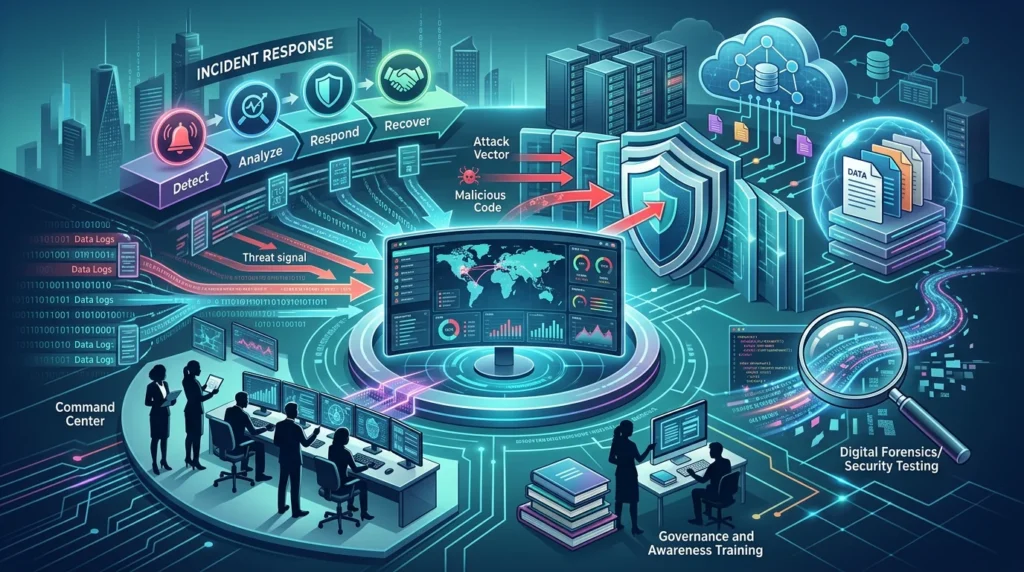
An incident-response capability enables an organization to respond systematically when a security incident occurs. A typical lifecycle includes:
Preparation → Detection/Identification → Analysis → Containment → Eradication → Recovery → Lessons learned
Different frameworks may use somewhat different terminology, but the underlying objectives remain similar.
| Phase | What it involves |
|---|---|
| Preparation | Policies, incident-response plan, roles and responsibilities, contact lists, tools, communication channels, training and exercises |
| Detection and Analysis | Determine what happened, when, which systems are affected, whether it is still occurring, what information may be affected, and severity and business impact |
| Containment | Limit the spread and impact of the incident |
| Eradication | Remove the cause of the compromise, such as malware or compromised credentials |
| Recovery | Restore systems safely and monitor them for recurrence |
| Lessons Learned | Identify root causes, control failures, improvement opportunities, required policy changes and whether additional controls are required |
🔍 Incident Response: Audit Considerations
An auditor should determine whether:
- an incident-response policy exists;
- incident categories and severity levels are defined;
- responsibilities are assigned and escalation criteria exist;
- incidents are documented and evidence is preserved;
- legal/regulatory notification requirements are identified;
- communication procedures are established;
- incident-response exercises are conducted;
- lessons learned are documented;
- corrective actions are tracked to completion.
🎯 A Common CISA Principle
The auditor should not focus only on whether the organization responded to previous incidents. The audit should also determine whether the organization is prepared to respond to future incidents.
SOAR: Security Orchestration, Automation and Response
SOAR platforms integrate security tools and automate predefined response activities. For example:
SIEM alert → SOAR playbook → Enrich indicator → Check threat intelligence → Disable compromised account → Create ticket → Notify analyst
Automation creates its own risks. The auditor should consider whether automated actions are authorized, playbooks are tested, actions are logged, human approval is required for high-impact actions, excessive automation could disrupt legitimate activity, and changes to playbooks are controlled.
🎯 Exam Point
Automation should be appropriately governed. Faster response is not automatically better if an incorrect automated action can cause significant business disruption.
Evidence Collection and Forensic Investigation
When an incident may lead to disciplinary, regulatory or legal action, evidence must be collected and preserved carefully. Digital evidence may include:
files emails system logs network traffic database records memory browser artifacts mobile-device data cloud records authentication records metadata
The objective is to determine: What happened? Who or what was involved? When did it happen? How did it happen? What was affected?
Types of Computer Forensics
| Type | Focus |
|---|---|
| Disk/File-system forensics | Files, deleted files, metadata and storage artifacts |
| Memory forensics | Volatile information in RAM |
| Network forensics | Network traffic and communication |
| Database forensics | Database activity and records |
| Email forensics | Email messages, headers and related artifacts |
| Mobile forensics | Smartphones and tablets |
| Cloud forensics | Evidence from cloud environments |
| Application forensics | Application activity and artifacts |
Computer Forensic Techniques
forensic imaging hashing file-system analysis deleted-file recovery timeline analysis memory analysis log analysis network analysis malware analysis metadata examination correlation of evidence sources
Hashing
A cryptographic hash can be used to demonstrate that a forensic copy has not changed. For example:
Original image → Hash calculated → Evidence preserved → Image analyzed → Hash recalculated
If the relevant hash values remain consistent, this provides evidence of integrity.
Chain of Custody
Chain of custody documents the history and handling of evidence from collection through storage, transfer, examination and eventual disposition. A chain-of-custody record may include:
unique evidence identifier description of evidence date/time collected location person who collected it method of collection hash value storage location each transfer recipient date/time of transfer purpose of examination
Evidence that has been improperly handled may have its integrity or admissibility challenged.
🎯 CISA Perspective
The auditor should verify that evidence-handling procedures exist and that evidence is protected from unauthorized alteration, loss or destruction.
Best Practices for Securing Digital Evidence
Digital evidence should be:
- collected by authorized and appropriately trained personnel;
- protected from modification;
- securely stored and access-controlled;
- appropriately hashed and documented;
- transferred using controlled procedures;
- retained according to legal and organizational requirements;
- handled according to applicable forensic procedures.
The original evidence should generally be preserved while analysis is conducted on an appropriate forensic copy.
Digital Forensic Process: Audit Perspective
A useful way for CISA candidates to remember the forensic process is:
Acquisition → Imaging → Extraction → Interrogation → Ingestion → Normalization → Analysis/Reporting
| Step | What happens |
|---|---|
| 1. Data Acquisition | Identify and acquire relevant data from systems, devices, applications or other sources. Audit consideration: was the acquisition authorized and performed using an appropriate method? |
| 2. Imaging | Create a forensic copy of storage media or other relevant data. Audit consideration: was the original evidence preserved and was integrity verified? |
| 3. Extraction | Extract relevant artifacts such as files, deleted data, metadata, logs, browser history, emails and system artifacts. |
| 4. Interrogation | Examine the extracted information to identify relevant evidence and relationships. |
| 5. Ingestion | Load evidence into forensic or analytical tools for further processing. |
| 6. Normalization | Convert data from different formats into a consistent representation so that information can be correlated and analyzed. |
| 7. Reporting | Present findings clearly: methodology, evidence examined, relevant observations, timelines, findings, limitations and conclusions supported by evidence. |
Putting Security Monitoring Together
CISA candidates should understand how the different technologies work together. A simplified security monitoring ecosystem:
Users & Systems
↓
Logs / Events / Alerts
↓
IDS/IPS / Endpoint / Network / Application Monitoring
↓
SIEM
↓
SOC / Security Analysts
↓
Incident Response
↓
SOAR / Automated Actions
↓
Investigation & Forensics
↓
Evidence / Lessons Learned / Control Improvements
The auditor’s role is to determine whether the overall process is appropriately designed and operating effectively.
Security Event Management: What Should the Auditor Look For?
A useful audit framework is to consider five questions:
| Audit question | What the auditor examines |
|---|---|
| Are controls defined? | Policies, standards, procedures |
| Are controls implemented? | Tools, processes and responsibilities |
| Are controls operating? | Logs, reports, records and evidence |
| Are controls effective? | Testing, metrics, incidents and outcomes |
| Are weaknesses corrected? | Remediation and follow-up |
This approach prevents the audit from becoming a simple checklist exercise. For example, if an organization claims “We have a SIEM,” the auditor should go beyond verifying that the SIEM exists and determine:
Critical systems connected? → Relevant events collected? → Events correlated? → Alerts generated? → Alerts investigated? → Incidents handled? → Records retained? → Process effective?
CISA Audit Mindset: The Most Important Takeaway
A recurring theme throughout Domain 5B is the difference between knowing that a security technology exists and determining whether it actually provides effective control.
| Organization says… | Auditor should ask… |
|---|---|
| “We have antivirus.” | Is it deployed, updated, monitored and effective? |
| “We conduct vulnerability scans.” | Are findings prioritized, remediated and retested? |
| “We have a SIEM.” | Are critical events collected, correlated and investigated? |
| “We have a SOC.” | Are monitoring and response processes actually effective? |
| “We have incident response procedures.” | Have they been tested and improved? |
| “We have backups.” | Can systems actually be restored successfully? |
| “We collect logs.” | Are logs complete, protected, retained and reviewed? |
| “We conduct security awareness training.” | Does it change behavior and reduce risk? |
| “We preserve evidence.” | Is integrity and chain of custody maintained? |
| “We use automation.” | Are automated actions controlled and appropriately authorized? |
🧠 The Core CISA Mindset
Do not audit the presence of a control alone. Audit its design, implementation, operation and effectiveness.
❓ The Most Important Audit Question
For almost every security-event-management scenario, ask: what evidence would demonstrate that the control is properly designed, implemented, operating and effective?
That question captures the fundamental difference between a security practitioner and a CISA auditor.
https://thecyberskills.com/cisa-domain-5-information-asset-security/