Canvas Data Breach Incident Details
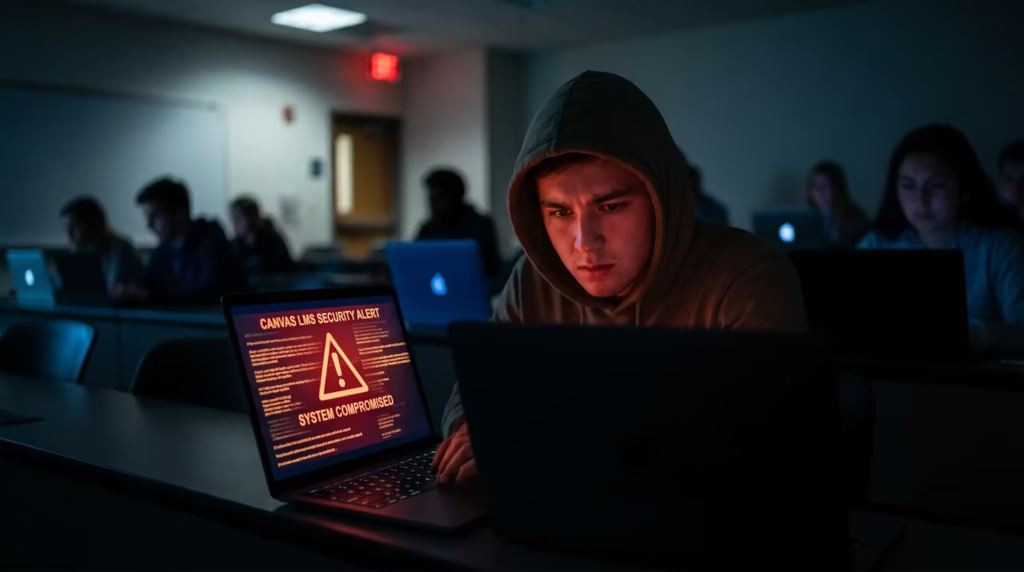
On April 29, 2026, Canvas LMS, one of the most widely used learning management systems in the world, was hit with a large-scale cyber incident that impacted the education sector globally. Canvas LMS is developed and operated by Instructure, an education technology company based in the United States. Schools, colleges, universities, and training providers use Canvas to manage online classes, assignments, grades, messages, tests, and student contact.
Instructure detected unauthorized activity on April 29, 2026, and immediately revoked the unauthorized party’s access. A second related access attempt on May 7, 2026, prompted the company to take additional protective measures and temporarily move Canvas into maintenance mode right in the middle of finals season for many US universities.
The hacking group ShinyHunters claimed responsibility and said it stole 3.65 TB of data, comprising approximately 275 million records from 8,809 educational institutions worldwide. The exposed data was confirmed to include names, usernames, email addresses, student ID numbers, course titles, enrollment information, and private messages.
What Is Canvas LMS? And Why Should You Care About This Breach?
In simple words, Canvas LMS is a digital classroom platform. Schools and universities use it to run courses online, share study material, collect assignments, post grades, send announcements, host lecture videos, manage quizzes, and allow students and teachers to communicate. With tens of millions of users across more than 100 countries and support for 33 languages, Canvas is not just another school website; it is critical academic infrastructure.
A normal website breach may expose emails or passwords. A learning platform data breach can touch daily academic life: student identity, class enrollment, course communication, assignment deadlines, exam preparation, and teacher messages. That is why this Canvas hack became a major cybersecurity story worldwide and why US parents, students, teachers, and school administrators are right to take it seriously.
Who Claimed Responsibility? ShinyHunters
The hacking group ShinyHunters claimed responsibility for the Canvas cyberattack. The group has a well-documented history of targeting global companies for extortion and has been linked to multiple high-profile data breaches. Notably, this was the second ShinyHunters attack against Instructure in under eight months; the first, in September 2025, exploited a social engineering attack against the company’s Salesforce environment.
ShinyHunters claimed to have stolen 3.65 TB of data, including approximately 275 million records from 8,809 educational institutions. On May 7, 2026, the group defaced Canvas login pages and issued a public ransom deadline, threatening to leak the data if schools did not pay. The Canvas incident fits a clear pattern of education sector ransomware and extortion attacks that has accelerated globally since 2020.
What Student Data Was Exposed?
Instructure confirmed that the data involved included names, usernames, email addresses, student ID numbers, course names, enrollment information, and Canvas messages. CrowdStrike, the forensic firm engaged by Instructure, found no evidence that passwords, dates of birth, Social Security numbers, government identifiers, or financial information were compromised.
Core learning data such as course content, assignment submissions, grades, and login credentials was also stated to be unaffected.
How Many Schools and Universities Were Affected?
The breach struck during finals season, making its impact immediately visible across the United States. Harvard students temporarily lost access to Canvas after the university was listed among thousands of affected schools. Columbia University, Rutgers, Princeton, Kent State, and Georgetown all issued statements alerting students. School districts in California, Florida, Georgia, Oklahoma, Oregon, Nevada, North Carolina, Tennessee, Utah, Virginia, Texas, and Wisconsin also reported being affected.
James Madison University postponed final exams originally scheduled for Friday, May 9, rescheduling them to Wednesday, May 13. The University of California system stated that Canvas access would not be restored until it was confident the system was secure. The California State University system issued campuswide updates and monitored the breach closely.
| Institution / System | Reported Impact |
|---|---|
| Harvard University | Students temporarily lost Canvas access; university listed among affected schools |
| Columbia, Princeton, Rutgers, Georgetown, Kent State | Issued student alerts; disruption to coursework and exam preparation |
| James Madison University | Final exams postponed from May 9 to May 13 |
| University of Illinois | Issued a public cybersecurity event statement |
| Penn State University | Published outage updates; adjusted exam and deadline guidance |
| University of California System | Restricted Canvas access until security was confirmed; fully restored May 11 |
| California State University System | Campuswide outage updates; monitored the breach closely |
| ~8,809 institutions worldwide | Claimed by ShinyHunters; confirmed by threat intelligence |
The Ransom Question: Did Instructure Pay?
On May 11, 2026, Instructure announced it had reached an agreement with the unauthorized actor. The company said the stolen data was returned, that it received digital confirmation of data destruction in the form of shred logs, and that no Instructure customers would be extorted publicly or privately as a result of the incident. The agreement covered all impacted customers.
Instructure did not publicly disclose the terms of the agreement or confirm the amount paid, though unconfirmed reports suggest a figure of US$10 million. Multiple cybersecurity experts and news outlets interpreted the company’s carefully worded statement as a sign that a ransom was paid. When directly asked twice by WRAL News, a spokesperson redirected to the status page without a clear answer. Instructure CEO Steve Daly publicly apologized, stating, “You deserved more consistent communication from us, and we didn’t deliver it.”
The wider concern is clear: even when a company receives shred logs or digital proof of deletion, the public cannot fully verify that no copy of the stolen data still exists elsewhere.
As of May 20, 2026, Instructure’s latest update confirmed the investigation was still ongoing, with forensic analysis continuing. This incident should not be treated as fully closed.
Current Situation: Is Canvas Safe to Use Now?
Instructure says Canvas is fully back online. The company has blocked unauthorized access, patched the exploited vulnerability, revoked privileged credentials and access tokens, rotated internal keys, and found no evidence that the threat actor currently has access to the platform. CrowdStrike was brought in to support forensic analysis and further harden the environment, and an additional expert vendor was engaged to conduct a comprehensive review of the data involved.
Instructure also permanently shut down the Free for Teacher product, notably because the attacker exploited a vulnerability in that environment to gain initial access.
Why Student Data Breaches Are Especially Dangerous
Student data is not the same as ordinary customer data. It may involve minors, young adults, parents, teachers, school emails, private messages, class histories, and institutional records. The US Department of Education has stated that breaches of educational data are common and can lead to negative consequences for students, including identity theft, fraud, and extortion.
The Canvas incident is a reminder that education technology has become core infrastructure for academic life. If the platform goes down, learning is disrupted. If its data is exposed, students and staff face targeted scams long after classes resume, making this a long-tail risk, not a one-time event. On May 13, 2026, a proposed class action lawsuit was filed against Instructure in the US District Court for the Southern District of California on behalf of a San Diego resident, citing exposure of personally identifiable information.
What Schools and Universities Should Do Right Now
Schools should not wait for a perfect final report before taking basic protective steps. Communicate clearly with students, parents, faculty, and staff about what is known, what is still being reviewed, and what actions users should take.
- Warn users about phishing emails, fake Canvas messages, fake grade alerts, fake assignment links, and fake IT support requests.
- Monitor Canvas administrative activity, integrations, single sign-on logs, unusual login patterns, and privileged accounts.
- Review third-party tools connected to Canvas; those integrations can create additional exposure points.
- Maintain LMS outage continuity plans covering exams, assignment deadlines, and faculty-student communication so that critical academic work can continue even when the platform is unavailable.
What Students and Parents Should Do Right Now
Students and parents should treat this as a privacy and phishing risk, not only a temporary outage. Never click unexpected links claiming to come from Canvas, school IT, financial aid, a teacher, or a university office; always go directly to the official school or Canvas login page.
- Change passwords on other accounts if you reused your Canvas password anywhere else.
- Enable multifactor authentication (MFA) wherever available, especially on school email accounts.
- Parents: Watch for messages referencing real school names, course names, teacher names, deadlines, or payment instructions. Context makes a scam convincing; a criminal with your child’s course details can sound completely believable.
- Do not share any personal information in response to unexpected messages, even if they appear to come from your school or Canvas directly.
Recommendations for Education Authorities and Regulators
Education authorities should treat this incident as a warning about concentration risk in education technology. When thousands of institutions depend on the same platform, one vendor incident can disrupt learning on a national or international scale.
- Require clearer and faster incident reporting from major education technology vendors; schools need timely information about what happened, what data may be involved, and what user actions are required.
- Strengthen vendor risk management: Before adopting or renewing major LMS contracts, review security controls, incident response timelines, vulnerability management, breach notification processes, data retention practices, and integration security.
- Mandate that every institution maintains an LMS outage continuity plan covering faculty-student communication, exam and deadline adjustments, access to critical course files, and verified student updates during an incident.
Lessons for Cybersecurity Teams
Lesson 1 — Third-Party Platforms Are Direct Operational Risks
Security teams should map which platforms are essential for exams, grading, attendance, messaging, and learning delivery. When those platforms are breached, the entire institution feels it, not just the IT department. This breach affected academic calendars, student deadlines, and graduation timelines at dozens of universities simultaneously.
Lesson 2 — Free or Low-Friction Services Need the Same Security Scrutiny as Production Systems
Instructure confirmed that the attacker exploited a vulnerability in the Free for Teacher environment to gain initial access and escalate privileges into the broader production system. Other education vendors should urgently audit free account environments, support ticket systems, account escalation controls, and cross-environment isolation. A free-tier entry point should never be a gateway to production data.
Lesson 3 — Communication Is a Core Part of Incident Response
Instructure CEO Steve Daly publicly acknowledged that the company did not give users the consistent communication they deserved during the incident. During an education platform outage, silence creates confusion, panic, and harmful decisions. Clear, regular updates allow students, parents, and faculty to make safer choices about their academic work and personal data.
Quick Action Guide
| Audience | Immediate Action | Why It Matters |
|---|---|---|
| Students | Use only official Canvas or school login pages. Enable MFA on school email. Avoid unexpected links. | Attackers may use real course context to make phishing look believable. |
| Parents | Watch for messages about grades, fees, account verification, or student records. Verify directly with the school. | Family members may trust a scam if it contains accurate school information. |
| Schools | Monitor Canvas activity, integrations, privileged accounts, and SSO logs. Alert users to phishing risks. | The breach creates follow-on phishing and account abuse risks. |
| Universities | Activate or prepare an LMS outage plan for exams, assignments, and critical communication. | Learning is disrupted even when internal university systems are safe. |
| Authorities | Require stronger breach reporting, vendor risk management, and continuity planning for education platforms. | One shared platform incident can become a system-wide education risk. |
Summary
- For schools: Digital learning needs digital resilience. Cybersecurity planning and learning continuity planning are now the same thing.
- For students and parents: Be alert for scams that use real school names, course names, and teacher details. Context makes a scam convincing.
- For education authorities: If one learning platform can affect nearly 9,000 institutions at once, how prepared is the education system for the next attack?
- For cybersecurity professionals: Free-tier and low-friction environments in enterprise software are a growing attack surface. They deserve the same scrutiny as production systems.
References
https://thecyberskills.com/category/learn-train/